Understanding Construction Bonds: Types, Requirements, and How They Work (2026 Guide)
Construction jobs run on trust—but trust alone doesn’t keep a project moving when schedules slip, subcontractors don’t get paid, or a contractor can’t finish. That’s where construction bonds come in.
If you’re a general contractor, subcontractor, project owner, or project manager, bonding can feel like a mix of paperwork, underwriting, and unfamiliar legal terms.
This guide breaks it down: the types of construction bonds, how bond guarantees work in the real world, common construction bond requirements for contractors, and practical steps for how to get bonded for construction projects—without fluff, fear tactics, or unrealistic promises.
You’ll also learn how payment bonds in construction interact with lien rights, why a surety bond vs insurance comparison matters, what underwriters actually look for, and how to avoid bond claims through day-to-day project controls. (Educational content only—not legal or financial advice.)
What a construction bond and who’s involved

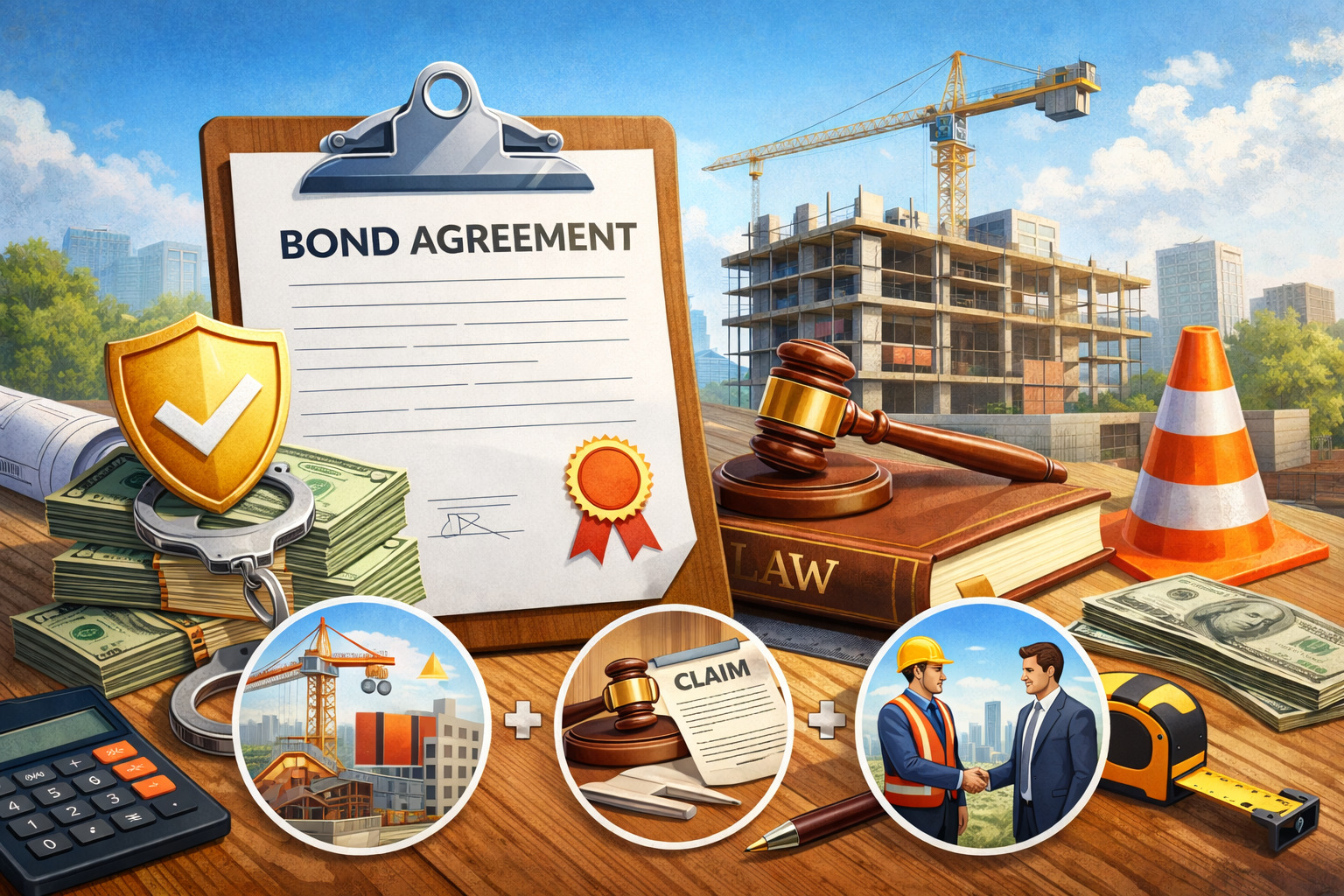
A construction bond is a three-party guarantee that a contractor will meet specific obligations—usually finishing the work and/or paying certain parties on the project. It’s not a “nice to have” on many jobs; it’s often a contract requirement, especially where the owner needs extra assurance that the project will be delivered as agreed.
At the center of every bond are three roles:
- Principal: the contractor (or sometimes a subcontractor) who is required to post the bond.
- Obligee: the party requiring the bond—typically the project owner, developer, or awarding authority.
- Surety: the bonding company that issues the bond and backs the guarantee.
What does “guarantee” mean in practice? It means the surety is promising the obligation that if the principal fails to perform the bonded obligation (for example, defaults on a contract or fails to pay qualified claimants), the surety will step in—up to the bond’s penal sum (the bond amount).
The surety’s response could include funding completion, arranging a replacement contractor, or paying valid claims, depending on the bond type and the bond’s terms.
This three-party structure is why bonds can feel different from other risk tools on a project. The surety is not betting that you’ll fail. A surety is evaluating whether you’re capable of succeeding—and backing you if you do.
Pro Tip: Think of bonding as “credit with conditions.” A surety is extending its financial strength to support your promise, but it expects to be repaid if it suffers a loss due to your default.
The bond “penal sum” and what it does (and doesn’t) cover
The penal sum is the maximum amount the surety may be responsible for under the bond. Many contractors hear “100% bond” and assume it means “the surety covers everything.” Not exactly. The penal sum caps the surety’s liability, and the bond language limits what obligations are covered.
In practical terms, the penal sum is the size of the surety’s guarantee to the obligee. If the contract is for 1,000,000 and the bond is written at 100%, the penal sum is 1,000,000.
If it’s written at 50%, the penal sum is 500,000. But the surety doesn’t automatically write a check for the penal sum—there’s a process, investigation, and specific conditions that must be met.
Also, bonds don’t necessarily cover every project problem. Disputes over scope, design issues, owner-caused delays, and contract interpretation can complicate a claim. The surety’s duty is defined by the bond and the bonded contract—not by what any one party “feels is fair.”
Surety bond vs insurance: what’s the difference (and why it matters)
A surety bond vs insurance comparison is one of the most important bonding concepts for contractors to understand, because it explains why surety underwriting is so detailed—and why the bond claim process works differently than an insurance claim.
Insurance is generally a two-party arrangement (insured + insurer) designed to spread risk. You pay a premium, and the insurer expects a certain percentage of losses across a large pool. If there’s a covered loss, insurance is intended to respond—often without expecting reimbursement from the insured (outside deductibles or fraud situations).
Surety bonds are different. A bond is a three-party credit guarantee. The surety expects no losses. When a surety pays, it typically expects to be reimbursed by the contractor (principal) under the indemnity agreement. That is why bonds protect the project/owner (the obligee), not the contractor.
Key implications for construction teams:
- A bond is not “extra insurance.” It’s a performance and payment guarantee to the obligee.
- The surety underwrites the contractor like a lender would—looking at financial strength, experience, and execution capacity.
- If the surety incurs a loss due to the contractor’s failure, the contractor and indemnitors are generally responsible for repayment.
Pro Tip: A contractor can be fully insured and still be unbondable. Insurance handles accidents and defined risks; bonding is about reliability and contract performance.
Indemnity explained without legal jargon
The indemnity agreement is the contractor’s promise to protect the surety from losses, costs, and expenses related to issuing bonds. It commonly includes the company and individual owners (and sometimes spouses or affiliated entities) as indemnitors.
Here’s the simplest way to think about it:
- The surety is backing your promise to the owner.
- If the surety has to spend money because you didn’t keep that promise, you agree to repay the surety.
That repayment concept is why sureties care so much about project controls, cash flow discipline, and the contractor’s ability to manage risk. It’s also why “bonded vs insured contractor” isn’t an either/or. Strong contractors are typically both: insured for operational risks and bonded to meet contractual requirements.
Types of construction bonds: what they guarantee and when you’ll see them

There are several types of construction bonds, and the right bond depends on the job’s structure, the owner’s risk tolerance, and the contract requirements. Some bonds support the bidding phase, some cover performance during construction, and others cover payment obligations or post-completion warranty periods.
Below is a practical overview of the most common bond types contractors encounter in their local market: bid bond construction, performance bond in construction, payment bonds in construction, and maintenance/warranty bonds. We’ll also cover contractor license bond needs and subdivision bonds at a high level.
Table 1: Types of construction bonds (quick comparison)
| Bond type | What it guarantees | Who it protects most directly | When it’s commonly used |
|---|---|---|---|
| Bid bond | Bidder will honor bid and provide required performance/payment bonds if awarded | Owner/awarding authority | Competitive bidding, especially public work and larger private bids |
| Performance bond | Contractor will complete the work per contract terms | Owner/obligee | After contract award for bonded jobs |
| Payment bond | Certain subs/suppliers/labor will be paid as required by bond terms | Claimants + owner (indirectly) | Often paired with performance bond on bonded jobs |
| Maintenance/Warranty bond | Contractor will correct defective work during a defined period | Owner/obligee | Post-completion warranty obligations |
| Contractor license bond | Contractor will comply with licensing rules and certain statutory obligations | Public/consumers/authority | Licensing and permit requirements |
| Subdivision bond | Developer/contractor will complete public improvements (streets, utilities, drainage) | Local authority + community (indirectly) | Land development/subdivision approvals |
Pro Tip: On many projects, “performance and payment” are packaged together, but they protect different parties and trigger different claim paths.
Bid bond construction: how bid bonds work and common misconceptions
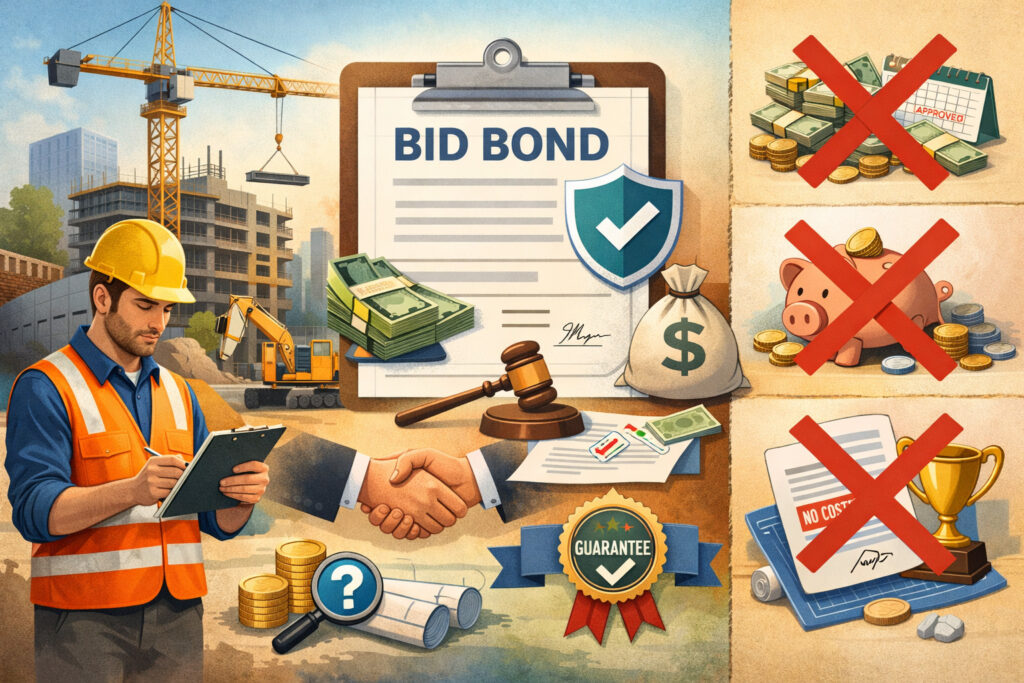
A bid bond construction requirement shows up most often on competitive bids where the owner wants to discourage “phantom bids” and ensure the low bidder will actually sign the contract at the bid price. In plain terms: a bid bond says, “If we win, we’ll proceed—and we’ll provide the required final bonds.”
What a bid bond typically guarantees:
- The bidder will enter into the contract if awarded.
- The bidder will provide required performance and payment bonds (if specified).
- If the bidder refuses, the surety may be liable for a defined amount—often tied to the difference between the low bid and the next qualified bid, up to the bond penal sum.
When bid bonds are required:
- Competitive solicitations where the owner needs bid integrity.
- Projects where rebidding would create costly delays.
- Jobs that require proof of contractor seriousness before award.
Typical triggers for a bid bond claim:
- The contractor refuses to execute the contract after award.
- The contractor cannot provide final bonds required by the bid documents.
- Contractor withdraws bid improperly (depending on bid rules and timing).
Common misconceptions:
- “A bid bond means I’m fully bonded for the project:” Not exactly. It’s an entry ticket. You still need underwriting approval for final bonds.
- “If I submit a bid bond, I’m locked in no matter what:” Bid rules matter. Some bid documents allow withdrawals under specific circumstances; others do not.
- “Bid bonds are just paperwork:” A bid bond is a real guarantee. Sureties take repeated bid-bond issues seriously because they reflect estimating and execution discipline.
Pro Tip: Treat bid bonds as a promise made by both you and your surety. If you bid aggressively without a realistic plan, you’re risking future bonding capacity—not just one job.
Performance bond in construction: what it covers and what owners expect

A performance bond in construction is the bond owners care about most when they worry about job completion. It guarantees that the contractor will perform the work according to the contract—scope, quality standards, and timelines as defined by the agreement.
When a performance bond is required:
- Many public work contracts.
- Larger private projects where the owner has lender or investor requirements.
- Projects with critical schedules (tenant move-ins, seasonal deadlines, phased openings).
- Situations where the owner has limited tolerance for contractor default.
What can trigger a performance bond claim:
- Contractor default (as defined in the contract and bond).
- Failure to mobilize or maintain progress.
- Abandonment of the project.
- Persistent defective work not corrected after notice (depending on contract language and cure opportunities).
What the surety may do after a valid default is declared (varies by bond form):
- Provide financial support to the existing contractor to finish.
- Arrange for a replacement contractor.
- Take over and complete the project through a completion contractor.
- Pay the obligee for covered losses up to the penal sum (less common as a first choice, but possible depending on circumstances).
What performance bonds do not do well:
- Solve a messy contract dispute where fault isn’t clear.
- Cover owner-driven changes without proper change orders.
- Replace project management fundamentals.
Pro Tip: The fastest path through a performance-bond situation is clean documentation—daily reports, approved schedules, written notices, and signed change orders. “We talked about it in the trailer” is rarely enough.
Mini-case study: performance bond friction caused by change orders
A GC is building a small commercial shell. Midway through, the owner requests multiple layout changes and upgrades finishes but delays approving change orders. The GC slows procurement to avoid buying upgraded materials without authorization. The owner claims the job is behind schedule and threatens a performance bond claim.
What happens next in real life is usually not dramatic—it’s administrative. The surety asks for:
- Original contract and specifications
- Approved schedule and updates
- Change order log and owner directives
- Notices sent and responses received
- Payment applications and approvals
If the GC’s documentation shows owner-driven scope growth without signed changes, the surety may push the parties back to contract resolution rather than treating it as a contractor default. This is why performance bonds reward disciplined contract administration.
Payment bonds in construction: what they cover and how they interact with lien rights
Payment bonds in construction are designed to ensure that certain project participants—typically subcontractors, laborers, and suppliers—get paid for work and materials provided under the bonded contract.
Payment bonds are especially common where lien rights are limited or where the owner wants extra protection from payment disputes.
Here’s the contractor-friendly view: a payment bond is meant to reduce the risk that unpaid parties will disrupt the project, file claims, or create title and closeout issues for the owner. But it also creates a formal claim channel that subcontractors and suppliers can use if payment breaks down.
Who can usually file a payment bond claim (general concept):
- First-tier subcontractors
- Certain lower-tier subcontractors (varies by bond form and project type)
- Suppliers who furnished materials to the bonded job
- Laborers and certain service providers (depending on bond language)
This is where payment bond vs lien rights becomes a practical conversation. On some projects, a bond can act as an alternative remedy to liens, or it can exist alongside lien rights. The details depend on the job and the bond form, so always read the bond and contract documents.
How lien waivers and bond claims connect:
- Owners often collect lien waivers with progress payments.
- Waivers can impact a claimant’s ability to pursue a lien and may also affect bond claim arguments if improperly handled.
- Clean waiver collection protects everyone: owner, GC, and subs.
Pro Tip: A payment bond isn’t a substitute for good pay-app processes. Fast, accurate pay apps with clear backup (verified percent complete, stored materials documentation, change order status) reduce disputes that turn into claims.
Mini-case study: supplier claim driven by paperwork gaps
A supplier delivers materials to a project under a sub’s purchase order. The sub gets paid but doesn’t pay the supplier (cash flow issue). The supplier files a payment bond claim. The GC believes the supplier is “not their problem.”
In the claim review, the surety asks:
- Proof of delivery to the bonded project
- Purchase orders and invoices
- Notices (if required)
- Payment history and outstanding balances
If the supplier proves the materials were delivered and remain unpaid, the surety may pay and then seek reimbursement under the indemnity agreement—often putting pressure back on the GC to tighten waiver collection and verify that subs are paying downstream parties.
Maintenance bond / warranty bond: why owners ask for them after completion
A maintenance bond / warranty bond (often called a maintenance bond) extends protection into the post-completion period. It generally guarantees that the contractor will correct defective workmanship or materials discovered during a defined maintenance term—commonly tied to the contract’s warranty period.
When maintenance bonds are used:
- Projects with critical systems where defects are costly (roofing, waterproofing, sitework, utilities).
- Jobs where the owner has experienced poor warranty follow-through.
- Projects with lender or investor-driven risk controls.
Common triggers:
- Covered defects discovered during the maintenance period.
- Failure to respond to warranty calls as required by the contract.
- Incomplete closeout items that were agreed to be finished post-substantial completion (depending on bond terms).
Common misconceptions:
- “Maintenance bonds cover normal wear and tear:” Typically, no.
- “If the owner changes how they use the building, the bond still covers issues:” Usually not if misuse causes the problem.
- “It’s just another premium:” A maintenance bond can affect underwriting because it extends the surety’s exposure into the future.
Pro Tip: Treat closeout like you treat mobilization—plan it early. A clean punch list process, clear O&M manuals, and documented commissioning reduce warranty disputes that can become bond friction.
License and permit bonds: contractor license bond and related obligations (high-level)
A contractor license bond is different from performance and payment bonds. It typically guarantees that the contractor will comply with licensing rules and certain statutory obligations tied to the contractor’s license. It’s often a condition of obtaining or keeping a license—not tied to one specific project.
What license/permit bonds generally do:
- Provide a financial remedy if the contractor violates certain rules (examples can include failure to follow licensing requirements or specific consumer protections).
- Offer reassurance to the licensing authority and the public that there’s a backstop if obligations aren’t met.
What they generally do not do:
- Guarantee project completion for a specific owner (that’s what performance bonds do).
- Guarantee payment to subs and suppliers on a specific job (that’s payment bonds).
Why this matters operationally:
- Contractors sometimes assume having a license bond means they’re “bonded.” Owners usually mean performance/payment bonds when they ask if you’re bonded.
- License bonds can still involve claims and can affect underwriting if there’s a history of violations.
Pro Tip: Keep your bond file organized: license bonds, permit bonds, and project bonds. Owners and awarding authorities may ask for proof quickly, and delays can cost award opportunities.
Subdivision bonds: what they are and where they show up
Subdivision bonds most often appear in land development: streets, sidewalks, drainage, utilities, and other public improvements required as part of a development approval. The obligee is typically a local authority or utility entity requiring assurance that the improvements will be completed to standard.
Why subdivision bonds exist:
- Development projects can stall due to financing, sales pace, or contractor issues.
- The community and local infrastructure shouldn’t be left with unfinished roads or unsafe site conditions.
How subdivision bonding usually works (high-level):
- The bond amount is often tied to the estimated cost of the required improvements.
- Release may be phased as work is completed and accepted.
- Maintenance obligations may follow acceptance, sometimes with a separate maintenance period.
Common contractor misconceptions:
- “Subdivision bonds are only the developer’s issue.” Contractors performing the work can still be involved in the bonding and closeout process.
- “Once it’s paved, we’re done.” Acceptance testing, as-builts, and punch-list items can drive release timing.
Pro Tip: On subdivision work, track approvals like you track production. Inspections, test results, and as-built drawings are often what controls bond release—not just physical completion.
Construction bond requirements for contractors: when bonds are required and typical amounts
Construction bond requirements vary widely by owner, project type, and risk profile, but there are patterns contractors see repeatedly. Owners require bonds when the cost of contractor failure is high—financially, operationally, or politically—and when they need a reliable remedy that doesn’t depend solely on litigation.
Common reasons owners require bonds:
- Protect the project schedule and completion certainty.
- Reduce risk of nonpayment to qualified subs/suppliers.
- Satisfy lender, investor, or program requirements.
- Establish fair competition (bonded bidders are typically prequalified).
- Reduce closeout issues tied to payment disputes.
Public works bonding requirements (high-level) and Miller Act basics
Many public work contracts require performance and payment bonds as a baseline. On certain federally funded projects, bonding requirements may follow what’s commonly referred to as the Miller Act framework (high-level concept), which generally requires performance and payment bonds for covered contracts above specified thresholds.
Important practical takeaway:
- If you pursue public work, expect bonding to be part of the standard bid package.
- Bid bonds may be required at bid time, followed by performance and payment bonds upon award.
Because requirements can change and can differ by agency and project, always confirm the bond forms and percentages in the solicitation and contract.
Typical bond amounts (ranges, not promises)
Bond amounts are commonly expressed as a percentage of the contract value, but the exact number depends on the owner and the project:
- Bid bonds: often a percentage of the bid amount (commonly in a small-to-moderate range).
- Performance bonds: frequently up to 100% of the contract amount on many bonded jobs, but not always.
- Payment bonds: often paired with performance and may also be up to 100% of contract value, depending on requirements.
- Maintenance bonds: often a smaller percentage, tied to warranty exposure and the owner’s preferences.
Pro Tip: When reviewing a bid package, don’t just look for “bond required.” Look for: bond form, percentage, whether the bond covers approved change orders, and any special notice/default language that can affect the claim process.
Table 2: Bond requirements by project type (general guidance)
| Project type | Common bond requirements | Why owners use them | Typical contractor impact |
|---|---|---|---|
| Private projects | Often none on smaller jobs; may require performance/payment on larger or lender-driven projects | Protect schedule, lender risk controls, reduce closeout issues | Prequalification, financial reporting, tighter contract admin |
| Public works | Bid bond + performance + payment are common | Accountability, protection of downstream parties, standardized procurement | Strong compliance requirements, formal notices, strict documentation |
| Subdivision / development improvements | Subdivision bonds, sometimes maintenance | Ensure completion of public improvements and long-term quality | Inspection-heavy, phased releases, as-built and test documentation |
How bond pricing works in 2026: premiums, rate ranges, and what drives cost
Contractors understandably ask: “How much will the bond cost?” The honest answer is: it depends on your company’s risk profile, the project, and the surety’s underwriting view. Still, you can understand how pricing works and what influences it.
Bond premium basics
A bond premium is the cost you pay for the surety to issue the bond. It’s usually based on:
- The bond amount (penal sum)
- The bond term/type
- The surety’s rate tier for your account and the project
In many markets, bond premium rates (ranges, not promises) for well-qualified contractors on standard performance/payment bonds often fall somewhere in a low single-digit percentage of the contract amount, with better accounts lower and riskier accounts higher. Some bonds (like small license bonds) may have minimum premiums regardless of size.
Pricing is not a reward for optimism—it’s a reflection of:
- Financial strength
- Execution track record
- Claims history
- Project complexity and size
- Contract terms and owner profile
Pro Tip: Don’t chase the lowest bond rate at the expense of relationship and capacity. A responsive surety program that supports growth can be more valuable than a small rate difference.
Bonding capacity: what it is and how to grow it responsibly
Bonding capacity is the maximum amount of bonded work a surety is willing to support for your company. It usually includes:
- Single-job limit: the largest bond you can get for one project
- Aggregate limit: total bonded backlog allowed across all projects
Sureties look at capacity through a practical lens:
- Can the contractor manage the volume operationally?
- Is the contractor financially strong enough to carry the work (labor, materials, retainage)?
- Is backlog realistic compared to staffing, systems, and cash flow?
How to grow capacity responsibly:
- Build a consistent track record of profitable completion.
- Strengthen working capital and cash reserves.
- Improve job costing accuracy and forecasting.
- Maintain clean financial reporting and WIP schedules.
- Avoid disputes and claims through disciplined contract admin.
Surety underwriting and documentation: what they look for (and why delays happen)
Surety underwriting is the surety’s process of evaluating whether it should extend its guarantee to support your bonded obligations. Underwriters aren’t trying to “catch you.” They’re trying to confirm you can finish the work and manage the payment chain without default risk.
What sureties commonly request
Expect a documentation package that may include:
- Company financial statements (CPA-prepared often preferred for larger programs)
- Interim financials (recent internal statements)
- Work-in-progress (WIP) schedule and backlog report
- Bank reference and line of credit details
- Key project resumes and experience summaries
- Supplier and subcontractor references
- Owners’ personal financial statements (especially for closely held companies)
- Claim history explanation (if applicable)
- Organizational chart and key staff capabilities
What sureties are really evaluating:
- Profitability trends and margin stability
- Working capital and liquidity
- Leverage and debt structure
- Cash flow discipline and AR aging
- Job execution controls (scheduling, change management, sub management)
Pro Tip: Your WIP schedule is not “extra paperwork.” It’s one of the surety’s main tools for understanding whether your reported profit is real and collectible.
Common reasons applications get delayed or denied
Most bonding delays come from gaps—not from “bad luck.” Common issues include:
- Incomplete or outdated financials
- WIP schedule doesn’t reconcile with financial statements
- Large unapproved change orders inflating projected profit
- Heavy AR over 90 days without explanation
- Rapid growth without staffing and systems
- Thin working capital relative to backlog
- Prior claims without clear corrective action plan
- Overreliance on one customer or one project type
How to reduce underwriting friction:
- Keep a bond-ready file updated quarterly.
- Use consistent job cost codes and WIP reporting.
- Document change orders promptly (even if pending).
- Track retainage and cash needs for each job.
How the bond claim process works: who can file, notices, and resolution steps
The bond claim process depends on the bond type. Performance bond claims are typically filed by the obligee (owner/awarding authority). Payment bond claims are often filed by eligible subs, suppliers, or laborers under the bond terms. Maintenance bond claims are typically owner-driven.
Regardless of type, claims generally follow a predictable path: notice, documentation, investigation, and resolution. A claim is not automatically valid just because it is filed, and a surety won’t typically pay without confirming contractual and bond conditions are met.
Who can file (general guidance):
- Performance bond: usually the obligee/owner
- Payment bond: eligible claimants as defined by bond language (subs/suppliers/labor), sometimes with tier limits
- Maintenance bond: obligee/owner
Notice requirements (general):
- Many bonds require timely written notice to the contractor and surety.
- Payment bonds may require preliminary notices depending on claimant tier and bond form.
- Documentation must tie labor/material to the bonded project.
Pro Tip: Treat notices as routine project administration, not hostility. Written notice protects everyone by establishing a clean record early—before positions harden.
Table 3: Bond claim process steps (general timeline, docs, common issues)
| Step | Typical timing (varies by bond and contract) | Key documents | Common issues |
|---|---|---|---|
| 1) Claim notice submitted | After nonpayment/default conditions arise | Written notice, bond info, contract references | Late notice, wrong party notified, missing bond form |
| 2) Surety acknowledges and requests info | Soon after receipt | Claim form, supporting docs request list | Incomplete documentation, unclear scope tie-in |
| 3) Investigation and responses collected | Weeks to months depending on complexity | Contract, change orders, pay apps, delivery tickets, correspondence | Disputes over scope, setoffs, pay-when-paid arguments |
| 4) Determination/resolution path | After fact review | Proof of work/material, payment history, project status | Partial approvals, contested amounts, missing waivers |
| 5) Payment/completion action (if valid) | After determination | Releases/assignments, settlement agreements | Delay due to negotiations, documentation clean-up |
Practical ways to prevent claims (contract admin that actually works)
Preventing claims is less about “being strict” and more about being consistent:
- Use clear subcontract scopes and flow-down terms.
- Collect conditional waivers with each progress payment and unconditional waivers after funds clear (where applicable/allowed).
- Keep a current vendor ledger tied to each project.
- Address pay app disputes fast—don’t let them age into claims.
- Document backcharges with photos, tickets, and written notices.
- Keep change order logs current and communicate status weekly.
Best practices to stay bondable: field discipline that underwriters respect
Bondability isn’t only a financial statement issue. Sureties care about whether your company can consistently deliver projects without chaos, disputes, and surprise losses. The good news: many “bondability wins” come directly from field and PM habits.
Job costing discipline and forecasting
Underwriters love contractors who know their numbers in real time:
- Track cost-to-complete weekly or biweekly on active jobs.
- Compare production rates to estimate assumptions early.
- Flag margin fade immediately and build corrective action plans.
- Separate pending change orders from approved change orders in reporting.
Short, consistent forecasting cycles matter more than perfect forecasts. A contractor who catches problems at 20% complete is far less risky than one who discovers losses at 85%.
Pro Tip: “Accrual discipline” is bonding language for: don’t hide costs, don’t delay bad news, and don’t book profit you haven’t earned.
Change order documentation that prevents disputes
Change management is one of the biggest drivers of performance bond and payment bond conflict. Strong teams:
- Confirm scope changes in writing the same day
- Track directives and pricing status in a live log
- Separate time-and-material tickets from lump-sum changes
- Get schedule impacts recognized early, not at the end
This isn’t about being bureaucratic. It’s about preventing a situation where the owner believes you’re late, but you believe you’re working on added scope.
Project controls: schedules, RFIs, and submittals
Sureties tend to trust contractors who run projects with visible controls:
- Maintain a baseline schedule and update regularly
- Use RFIs to document clarifications and prevent rework
- Track submittals with due dates and approvals
- Keep daily reports consistent and factual
Even smaller contractors can adopt lightweight versions of these controls. Consistency beats complexity.
Cash flow management and retainage planning
Bonded jobs often involve retainage and slower payment cycles. Practical strategies include:
- Build cash flow forecasts per job, including retainage timing
- Align payment terms with subs and suppliers where possible
- Avoid front-loading without support (it creates dispute risk)
- Monitor AR aging weekly and escalate early
Subcontractor management that reduces payment bond risk
Payment bond claims often arise from subcontractor cash flow breakdowns. Strong GCs:
- Prequalify subs (licenses, insurance, references, capacity)
- Require detailed pay apps with backup
- Verify downstream payments where required by contract
- Address performance issues quickly before they become termination disputes
Pro Tip: If a sub is slow to provide waivers or backup, treat it as an early warning signal—not a paperwork annoyance.
Construction bond requirements: what contractors should expect by project stage
Understanding construction bond requirements is easier when you map them to project stages:
- Bid stage: bid bond construction requirements may appear in the solicitation.
- Award stage: performance and payment bonds are typically due after notice of award, before notice to proceed.
- Construction stage: bonds remain in force while work is performed; payment bond exposure tracks payment disputes.
- Closeout stage: maintenance bonds may start at substantial completion or final completion (depends on bond form).
Owners also sometimes require:
- Bonded change orders above a threshold
- Consent of surety for contract changes
- Continuation certificates
The best way to avoid surprises is to review bond language early—before pricing and schedule commitments are locked.
How to get bonded for construction projects: step-by-step checklist (2026)
If you’re asking “how to get bonded for construction projects,” the winning approach is to treat bonding like building a professional credit profile. That means picking the right surety partner and keeping your documentation current.
Step 1: Choose a surety agent/broker who understands construction
Look for someone who:
- Specializes in contractor bonding (not just general insurance)
- Can explain bond forms and owner requirements clearly
- Has access to multiple surety markets (useful as you grow)
- Helps you build a long-term bond program, not just one bond
Bring practical info to the first conversation:
- Project types you do
- Average contract size and largest completed project
- Current backlog and staffing
- Any past disputes or claims (be upfront)
Pro Tip: The right agent doesn’t just “shop rates.” They help you present your company to underwriters in the strongest, most accurate way.
Step 2: Assemble a bond-ready document package
A solid baseline package includes:
- Year-end financial statements (and interim statements if year-end is older)
- WIP schedule and backlog report
- AR/AP agings
- Bank line terms and current availability
- Key resumes and project history
- Reference list (owners, subs, suppliers)
- License info and organizational structure
- Claims/dispute explanation (if any)
For new contractors, the package may lean more heavily on:
- Owner experience
- Personal financial strength
- Smaller starting bond requests
- Strong project controls and references
Step 3: Submit, respond, and keep underwriting moving
Underwriting often becomes slow when responses are slow. Best practice:
- Assign one internal point person for bond requests (PM, controller, or owner)
- Respond to document requests within 24–48 hours when possible
- Be consistent—don’t send different versions of numbers to different parties
- Explain anomalies (big AR, margin swings, one-time expenses) proactively
Step 4: Maintain the bond program year-round (not just when you need a bond)
The easiest bonds are the ones issued inside a stable program. Quarterly habits that help:
- Update financials and WIP
- Review backlog and staffing
- Track change order exposure
- Keep a clean claim/dispute log (what happened, what changed)
“Getting bonded” readiness checklist (quick)
- Clear project history and resumes
- Updated financials and WIP schedule
- Clean AR aging with explanations for older items
- Documented estimating and change order process
- Standard subcontract templates and waiver process
- Cash flow forecast discipline, including retainage planning
- A surety relationship aligned with your growth plan
FAQs
Q1) What are construction bonds and why do they matter?
Answer: Construction bonds are three-party guarantees that a contractor will meet specific obligations—often completing the project and paying eligible parties. They matter because they reduce project risk, support orderly closeout, and are frequently required to bid or win certain jobs.
Q2) What’s the difference between a performance bond and a payment bond?
Answer: A performance bond focuses on completing the work per the contract. A payment bond focuses on paying eligible subs, suppliers, and labor under the bond terms. They often come as a pair, but they protect different parties and trigger different claim paths.
Q3) Are construction bonds the same as insurance?
Answer: No. A surety bond vs insurance comparison shows the difference: insurance spreads risk and expects losses across a pool; surety bonds are credit guarantees where the surety expects no loss and often requires reimbursement under an indemnity agreement if it pays.
Q4) When are bid bonds required?
Answer: Bid bonds are commonly required in competitive bidding when the owner wants assurance that the bidder will sign the contract and provide final bonds if awarded. They’re especially common on many public-style solicitations and larger private bids.
Q5) How much do construction bonds cost?
Answer: Costs vary based on contractor strength, project size, contract terms, and surety appetite. Bond premium rates are often quoted as a percentage, frequently in the low single-digit range for well-qualified contractors—but higher or lower is possible depending on risk factors. No rate is universal.
Q6) What is bonding capacity and how is it determined?
Answer: Bonding capacity is how much bonded work a surety will support—both a single-job limit and a total backlog limit. It’s determined by financial strength (working capital, liquidity), profitability, experience, staffing, and risk management discipline.
Q7) How do I get bonded as a new contractor?
Answer: Start with a surety-focused agent, build a clean documentation package, and request bonds sized to your experience. New contractors often grow capacity by completing smaller bonded jobs profitably, keeping strong bookkeeping/WIP reporting, and strengthening working capital over time.
Q8) What triggers a bond claim?
Answer: Triggers depend on bond type. Performance bond claims are often tied to contractor default or failure to perform. Payment bond claims are often tied to nonpayment of eligible parties. Maintenance bond claims relate to covered defects during the maintenance term.
Q9) How long does it take to get a bond?
Answer: It depends on your program maturity and the bond type. Contractors with an established bond program and updated financials can often obtain routine bonds faster than those assembling documents from scratch. Complex projects or larger bond requests typically require more underwriting time.
Q10) Do private projects require bonds?
Answer: Sometimes. Many smaller private projects don’t require bonds, but larger private jobs, lender-driven projects, and risk-sensitive owners often require performance and payment bonds—especially when schedule certainty is critical.
Q11) What is an indemnity agreement?
Answer: An indemnity agreement is the contractor’s promise to reimburse and protect the surety from losses and expenses related to bonds. It’s a core reason sureties underwrite contractors like credit risks rather than “insureds.”
Q12) Can a subcontractor be bonded too?
Answer: Yes. Some owners or GCs require subcontractor performance and payment bonds on critical scopes (major mechanical, structural, envelope, site utilities). Sub bonding can reduce performance risk but requires the sub to meet underwriting standards.
Q13) What’s the relationship between lien waivers and bond claims?
Answer: Lien waivers are often collected to reduce payment disputes and closeout risk. Waivers can affect lien rights and may impact bond claim arguments depending on project rules and documentation. Consistent waiver practices reduce the chance of bond claims.
Q14) What’s a maintenance bond and do I always need one?
Answer: A maintenance bond / warranty bond guarantees correction of covered defects during a defined period after completion. Not every project requires one, but owners may request it for high-risk scopes or where warranty follow-through is a concern.
Q15) What does “bonded vs insured contractor” mean to owners?
Answer: Owners often use “bonded” to mean you can provide performance/payment bonds when required. “Insured” means you carry liability and other insurance. Strong contractors are typically both, because bonds and insurance solve different problems.
Conclusion
Construction bonds are one of the clearest signals to owners that a contractor can be trusted with high-stakes work. But bonding isn’t just a form you submit at bid time—it’s the outcome of financial strength, project controls, and a track record of finishing what you start.
If you want fewer surprises, focus on the fundamentals: clean reporting, disciplined change orders, predictable payment processes, and proactive communication. That’s how you meet construction bond requirements for contractors, improve bonding capacity, and keep your company ready for bigger opportunities in your local market.