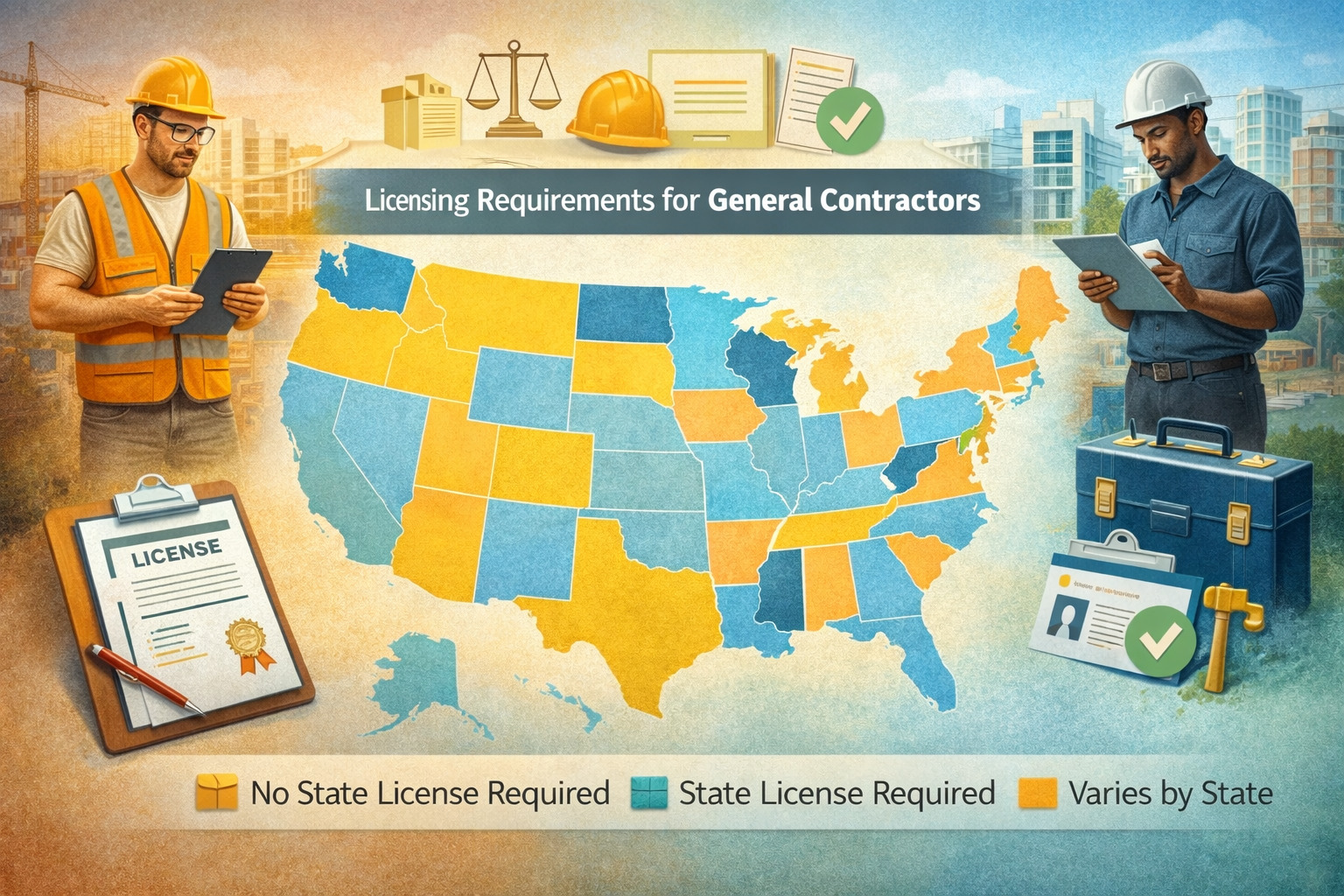
Licensing Requirements for General Contractors by State (2026 Complete Guide)
General contractor licensing is one of the fastest ways to separate “ready to bid” contractors from businesses that aren’t legally positioned to sign contracts, pull permits, or pass owner prequalification. In many states, a license is more than a credential—it’s the gatekeeper for bidding thresholds, lien rights, advertising rules, and enforcement protection when disputes arise.
Even where a state does not issue a single “general contractor” license, you may still face mandatory registration, local licensing, trade licensing, or home-improvement programs that function like licensing in practice.
Operating without the right credential can trigger stop-work orders, contract unenforceability, administrative penalties, and insurance complications. Owners and GCs also increasingly run a contractor license lookup as part of procurement—meaning your ability to win work can hinge on whether your classification, insurance, and renewal status are current.
This guide focuses on licensing requirements for general contractors by state in 2026: what’s required, who regulates it, and what you should confirm before bidding or mobilizing.
Because statutes, thresholds, and exam policies can change, use this as an informational roadmap and always verify final requirements directly with the applicable state contractor licensing board (and the city/county permitting authority where the project sits).
Quick Comparison: What “Licensing” Means Across States in 2026
If you’ve ever wondered why one state feels “paperwork-light” and the next feels like a full audit, it’s because contractor regulation is built around different risk models.
Some states regulate by scope (residential vs commercial), some by project value thresholds, and others by consumer protection (home improvement registration) or tax/workforce compliance (contractor registration tied to labor rules). A few states rely heavily on local licensing rather than state-level credentials.
Before you compare requirements, align on the vocabulary:
- License usually means the state issues a credential that authorizes contracting within defined classifications and monetary limits.
- Registration often means you can legally operate after filing, but it may not authorize you to pull permits, supervise all trades, or advertise as “licensed.”
- Endorsements and classifications define what you can build (and sometimes how large).
- Many states tie eligibility to experience requirements for contractors, exams, and bonding and insurance requirements.
To help you quickly triage states, use the table below as a “first pass,” then go deeper in the state-by-state section.
Table 1: Overview Comparison (Statewide License vs Registration vs Local Control)
Key: “License required?” = a statewide GC/building contractor license program exists for at least one major segment (commercial and/or residential). “Exam” may be trade, business/law, or both. “Bond/Insurance” varies by classification and consumer-protection rules.
| State | License required? | Exam? | Experience? | Bond/Insurance? | Renewal? |
|---|---|---|---|---|---|
| Alabama (AL) | Yes (commercial GC) | Yes | Yes | Often | Yes |
| Alaska (AK) | Yes (contractor + endorsements) | Often | Yes | Yes | Yes |
| Arizona (AZ) | Yes | Yes | Yes | Yes (license bond) | Yes |
| Arkansas (AR) | Yes | Often | Yes | Often | Yes |
| California (CA) | Yes | Yes | Yes | Yes (bond) | Yes |
| Colorado (CO) | No statewide GC (local) | Varies | Varies | Varies | Varies |
| Connecticut (CT) | Mostly registration programs + trade licensing | Varies | Varies | Often | Yes |
| Delaware (DE) | No single GC license; business licensing/registration applies | No/Varies | No/Varies | Varies | Yes |
| Florida (FL) | Yes | Yes | Yes | Yes | Yes |
| Georgia (GA) | Yes | Yes | Yes | Often | Yes |
| Hawaii (HI) | Yes | Yes | Yes | Yes | Yes (biennial cycle shown) |
| Idaho (ID) | Registration (and separate trade/public works licensing) | No/Varies | Varies | Varies | Yes (moving to biennial reg.) |
| Illinois (IL) | No statewide GC (local; trades often statewide/other) | Varies | Varies | Varies | Varies |
| Indiana (IN) | No statewide GC (local) | Varies | Varies | Varies | Varies |
| Iowa (IA) | Registration program exists (common for construction contractors) | No/Varies | Varies | Varies | Yes |
| Kansas (KS) | No statewide GC (local) | Varies | Varies | Varies | Varies |
| Kentucky (KY) | No single GC license (trades/permits vary) | Varies | Varies | Varies | Varies |
| Louisiana (LA) | Yes | Yes | Yes | Often | Yes |
| Massachusetts (MA) | Yes (CSL/HIC model) | Yes/Varies | Often | Often | Yes |
| Maryland (MD) | Home improvement licensing + specialty programs | Often | Often | Often | Yes |
| Michigan (MI) | Yes (residential builder/alteration) | Yes | Yes | Often | Yes |
| Minnesota (MN) | Yes (residential building/remodeling) | Often | Often | Often | Yes |
| Missouri (MO) | No statewide GC (local) | Varies | Varies | Varies | Varies |
| Mississippi (MS) | Yes | Yes | Yes | Often | Yes |
| Montana (MT) | Registration program | No/Varies | Varies | Often | Yes |
| North Carolina (NC) | Yes | Yes | Yes | Often | Yes |
| North Dakota (ND) | Yes | Yes/Varies | Often | Often | Yes |
| Nebraska (NE) | Registration program | No/Varies | Varies | Often | Yes |
| New Hampshire (NH) | No statewide GC (some trades/state programs) | Varies | Varies | Varies | Varies |
| New Jersey (NJ) | Home improvement registration + trade licensing | No/Varies | Varies | Often | Yes |
| New Mexico (NM) | Yes | Yes | Yes | Often | Yes |
| Nevada (NV) | Yes | Yes | Yes | Yes | Yes |
| New York (NY) | No statewide GC (local) | Varies | Varies | Varies | Varies |
| Ohio (OH) | Trades often statewide; GC/local varies | Varies | Varies | Varies | Varies |
| Oklahoma (OK) | No single GC license (trades vary) | Varies | Varies | Varies | Varies |
| Oregon (OR) | Yes | Yes | Often | Yes | Yes |
| Pennsylvania (PA) | Home improvement registration | No/Varies | Varies | Often | Yes |
| Rhode Island (RI) | Registration board (GC/contractor registration) | No/Varies | Varies | Often | Yes |
| South Carolina (SC) | Yes | Yes | Yes | Often | Yes |
| South Dakota (SD) | No statewide GC (tax/registration may apply) | Varies | Varies | Varies | Varies |
| Tennessee (TN) | Yes | Yes | Yes | Often | Yes |
| Texas (TX) | No statewide GC (trades vary) | Varies | Varies | Varies | Varies |
| Utah (UT) | Yes | Yes/Varies | Often | Often | Yes |
| Virginia (VA) | Yes | Yes | Yes | Often | Yes |
| Vermont (VT) | No statewide GC | Varies | Varies | Varies | Varies |
| Washington (WA) | Registration (contractor registration required) | No | No/Varies | Often | Yes |
| Wisconsin (WI) | Yes (dwelling contractor qualifier model) | Yes/Varies | Often | Often | Yes |
| West Virginia (WV) | Yes | Yes/Varies | Often | Often | Yes |
| Wyoming (WY) | No statewide GC | Varies | Varies | Varies | Varies |
Use this table to identify what kind of research you need next: state license, state registration, or local licensing. The state-by-state section below tells you what to confirm, which license classification types are common, and what typically triggers exam or experience requirements.
How General Contractor Licensing Works in Practice

Most contractor compliance problems come from treating “licensing” like a single checklist item. In reality, contractor authorization is usually a stack of requirements that can include a state credential, entity registration, tax licensing, local permitting, and qualifying-party rules.
Registration vs Full License: Why It Matters
A contractor registration vs license distinction is critical. Registration often means you’re on file with a state agency, but it may not prove technical competence, experience, or financial responsibility the way a license does. A full license typically requires:
- A qualifying individual (owner, partner, officer, or designated qualifier)
- Documented experience requirements for contractors
- Contractor license exam requirements (trade, business/law, or both)
- Proof of bonding and insurance requirements
- Periodic renewal with compliance attestations
A state may also separate business licensing for contractors (tax/business license) from contracting authorization. For example, some states require a business license for anyone “conducting business activities” even if the construction credential is local or based on registration.
Residential vs Commercial: Same Word, Different Rules
States frequently split a residential vs commercial contractor license because the risk profile differs. Residential programs may emphasize consumer protection—contracts, disclosures, and complaint resolution—while commercial licensing may emphasize financial capacity, bid limits, and classification scopes.
In Arizona, for example, licensing is structured around residential, commercial, or dual scope by classification, and licensing is centralized under the Registrar of Contractors.
Financial Responsibility: Bonds, Insurance, and Statements
Many applications require proof that your company can manage risk:
- Contractor license bonds (common in states with consumer-protection frameworks)
- General liability insurance (often minimum limits; sometimes higher for commercial tiers)
- Workers’ compensation coverage (or exemption filings, where allowed)
- Background checks and financial statements (especially when bid limits or creditworthiness are evaluated)
In some states, financial statements are explicitly part of the application package for certain classifications or license types.
Exams: What They Actually Test
Exams often come in two tracks:
- Trade/technical exam (plans, estimating, codes, safety, project management)
- Business/law exam (contracts, lien law, payroll/tax basics, risk management)
States may waive a trade exam through approved exam equivalents (see reciprocity section), but still require a business/law exam in-state.
State-by-State General Contractor Licensing Guide (Alphabetical)
This section is a state-by-state general contractor licensing guide designed for bidding and expansion planning. For each state, you should confirm:
- Licensing authority (the primary state agency/board)
- License types or credential model (license vs registration vs local)
- Typical experience and exam triggers
- Bonding/insurance expectations
- Renewal expectations
- Reciprocity notes (where applicable)
Important: Where local licensing controls general contracting, you must check city/county building departments and permitting offices in addition to state agencies.
A–C: Alabama, Alaska, Arizona, Arkansas, California, Colorado, Connecticut
Alabama
- Licensing authority: Alabama Licensing Board for General Contractors (commercial/industrial GC).
- License types: Major classifications and specialties; commercial GC focus.
- Experience/exam: Business & law exam is a common requirement; classification-based qualification.
- Renewal: Active renewal required; maintain classification and bid limits.
- Reciprocity notes: The Board publishes reciprocity information and participating states.
Alaska
- Licensing authority: Division of Corporations, Business and Professional Licensing – Construction Contractors.
- License types: Contractor registration/licensure with endorsements (residential endorsement exams are administered via contracted testing).
- Insurance/bond: Program emphasizes compliance and enforcement, with documentation required during application.
- Renewal: Ongoing compliance through the licensing unit.
Arizona
- Licensing authority: Arizona Registrar of Contractors (ROC).
- License types: Classification-based licensing with residential/commercial/dual scope.
- Experience/exam: Qualifying party typically must meet experience standards; applicants often complete trade and/or law exams depending on pathway; financial and bond obligations are part of the application package.
- Insurance/bond: License bond is commonly required; confirm the ROC bond schedule for your classification.
- Renewal: Periodic renewal; keep bond and insurance continuous.
Arkansas
- Licensing authority: Arkansas Contractors Licensing Board.
- License types: Commercial licensing and residential committee programs; thresholds and project types matter.
- Experience/exam: Board evaluates minimum standards including experience and financial stability; exams may apply based on license type.
- Renewal: Renewal and discipline rules are board-controlled.
California
- Licensing authority: Contractors State License Board (CSLB).
- License types: Multiple classifications, including “General Building” classification.
- Experience/exam: CSLB outlines when examinations are required for applicants.
- Bond/insurance: Contractor bond and other compliance requirements apply; confirm current bond amounts and workers’ comp rules via CSLB.
Colorado
- Licensing authority: No single statewide general contractor license; general contracting is typically local (city/county).
- License types: Local licensing models; some statewide licensing for specific trades exists under state agencies.
- Exam/experience/bond: Varies by jurisdiction; many local programs rely on ICC-style credentials or proof of experience.
- Renewal: Local renewal cycles; align with permitting jurisdictions where you work.
Connecticut
- Licensing authority: Department of Consumer Protection (DCP) for home improvement registration and many trade credentials.
- License types: “General contractor” work is often handled through registration programs for residential consumer contracting, plus trade licensing for regulated trades.
- Exams/experience: Many trade licenses require documented apprenticeship/experience; home improvement registration is a separate track.
- Renewal: Keep registrations current and confirm any insurance expectations.
D–F: Delaware, Florida
Delaware
- Licensing authority: Division of Revenue for contractor business licensing/registration requirements.
- Credential model: Delaware emphasizes business licensing for contractors; confirm whether your scope triggers additional specialty licensing or local requirements.
- Insurance/bond: Varies by project type and permitting authority; verify with local building departments and owner requirements.
- Renewal: Business licenses renew; monitor renewal dates to avoid lapses during active projects.
Florida
- Licensing authority: Department of Business and Professional Regulation (DBPR), Construction Industry Licensing Board (CILB).
- License types: Certified vs registered pathways (statewide vs local-authorization model); choose based on where you operate and the scopes you need.
- Experience/exam: Florida requires meeting experience criteria and passing required examinations for the credential pathway you pursue.
- Reciprocity notes: Florida publishes a reciprocity pathway for certified general contractor applicants licensed in states with reciprocity agreements; check DBPR for the current list and application requirements.
- Renewal/CE: Renewal cycles and continuing education requirements apply; track course completion and renewal windows carefully.
G–I: Georgia, Hawaii, Idaho
Georgia
- Licensing authority: State Licensing Board for Residential and Commercial General Contractors.
- License types: Tiered scopes and residential categories (e.g., residential-basic/light commercial) alongside general contracting tiers; verify which tier matches your project size and type.
- Experience/exam: Exam registration and eligibility are board-driven; rules outline qualifications for specific residential divisions.
- Renewal: Maintain active status and comply with any continuing education rules for your category.
Hawaii
- Licensing authority: Contractors License Board (PVL, DCCA).
- License types: General Engineering (A), General Building (B), and specialty “C” classifications are common frameworks; apply for the classification aligned with your work.
- Renewal: The Board publishes renewal guidance and timing (including even-year renewal cycles shown on its renewal information page).
- Insurance: Hawaii uses an online insurance certificate submission pathway; confirm certificate and limits required for your classification.
Idaho
- Licensing authority: Idaho Contractors Board (Division of Occupational and Professional Licenses).
- Credential model: Idaho emphasizes contractor registration for general contractors and separate licensing for certain trades and public works.
- Renewal: The Board notes a transition to biennial registration; monitor how this affects your renewal date.
- Practical tip: Registration is not the same as being “licensed” in a trade—ensure specialty subs meet subcontractor licensing requirements where regulated.
J–M: Typical Models (Local Licensing States vs Residential Builder States)
In the middle group of states, you’ll commonly see one of three models:
- Local licensing control (no statewide GC license): you’ll deal with city/county contractor licensing, plus state trade licenses where applicable.
- Residential builder/remodeler licensing: a statewide program focused on residential construction, repairs, and alterations.
- Home improvement registration: a consumer-protection registration for residential contracting, often separate from trade licensing.
When planning work here, build your compliance map around where permits are pulled. If a state is local-control, treat each municipality like a separate “state” for credentialing purposes.
If a state is residential-builder focused, confirm whether your projects are “new construction,” “remodel,” or “maintenance & alteration,” because the license classification types may differ.
And if the state uses a home improvement model, confirm whether your contract type triggers registration even when you don’t think of yourself as a “home improvement” contractor.
N–R: Licensure States, Registration States, and Home Improvement Programs
This block includes several of the most formal statewide programs (commercial contractor boards) and several registration-heavy states. The operational takeaway is simple: if you bid across multiple states, you must standardize your internal documentation so you can quickly satisfy each state’s application packet.
Common packet elements include:
- Entity documents (formation, good standing, assumed name filings)
- Qualifier documentation (experience affidavits, employment verification)
- Background checks and financial statements where required
- Proof of insurance and bond issuance
- Exam scores (state trade exam, business/law, or approved equivalency)
Also check whether the state allows you to “qualify” multiple entities or requires one qualifier per license. Multi-entity qualification is where many contractors accidentally fall out of compliance—especially during mergers, new LLC creations, or when a qualifier leaves.
S–W: Strong Licensing States and Contractor Registration States
By the time you reach S–W, you’re dealing with several states known for stricter enforcement and clear classification/renewal systems. Expect:
- Formal license tiers and scopes
- Stronger enforcement against unlicensed contracting
- Bonding/insurance and qualifying party scrutiny
- Clear renewal cycles—and meaningful penalties for lapsed status
In these states, treat licensing as part of your project controls. Add license status checks to your bid/no-bid workflow and vendor onboarding so you catch lapses before contract execution. Owners increasingly require evidence of licensing and active status at the time of bid, at award, and again at mobilization.
Multi-state reality check: Even where a state credential exists, local permitting can still impose additional steps. Always confirm local registration, business tax certificates, and permit pulling rules.
Reciprocity and Multi-State Licensing (What It Really Means)

Reciprocity is one of the most misunderstood areas in general contractor licensing laws by state. In practice, “reciprocity” rarely means you can simply transfer a license and start work tomorrow. More often, it means one of the following:
- The state will waive a trade exam if you’re licensed elsewhere and meet conditions (same classification, active status, good standing, experience verification).
- The state will accept an equivalent standardized exam score (common with NASCLA for commercial GC trade exams).
- The state will allow a streamlined application but still require state-specific business/law exams, financial responsibility proof, and bonding/insurance.
NASCLA Exam Acceptance (Not the Same as Full Reciprocity)
A practical multi-state tool is NASCLA Accredited Examination acceptance. NASCLA publishes a list of participating state agencies that accept the NASCLA commercial exam in lieu of a state trade exam requirement (while still requiring each state’s application and other conditions).
Florida Reciprocity Pathway Example
Florida outlines a reciprocity application pathway for certified general contractor applicants who are licensed in states with reciprocity agreements, and it points applicants to the board’s reciprocity list and requirements.
Table 2: Reciprocity Summary (How Multi-State Pathways Commonly Work)
| Pathway type | What it typically waives | What it does not waive | Best for |
|---|---|---|---|
| Formal state reciprocity agreement | Often trade exam and/or partial review | State application, fees, business/law exam, insurance/bond, background review | Contractors expanding into specific partner states |
| NASCLA exam acceptance | Trade exam in participating states | State application, classification rules, business/law exam, financial/bond/insurance | Commercial GCs targeting multiple participating states |
| Endorsement / out-of-state qualifier route | Some experience verification steps | Local permitting, entity registration, insurance/bond, renewal obligations | Firms moving a qualifier across entities |
| Local licensing portability | Sometimes none; each city/county decides | Most requirements remain local | Regional contractors in metro areas crossing municipal lines |
Common pitfalls to avoid:
- Assuming reciprocity grants the same scope (classification mapping can be stricter in the destination state).
- Applying under the wrong entity (qualifier’s experience may not match the applying company’s structure).
- Failing to keep the “home state” license active if the reciprocity pathway requires ongoing good standing.
- Ignoring local licensing after securing the state credential.
Steps to Get Licensed (General Process You Can Reuse)
Even though general contractor license requirements by state differ, most states follow a recognizable workflow. Build your internal “license factory” once, then customize it state-by-state.
1) Verify Eligibility and Scope
Start with scope mapping:
- Are you doing residential, commercial, or both?
- Will you self-perform multiple trades or primarily subcontract?
- Does the state regulate by project value threshold?
- Do you need a separate specialty/trade license for in-house crews?
Then confirm the regulator’s definitions and classification types before you spend money on exams or bonds.
2) Prepare Documentation (Make a Standard Packet)
A reusable packet typically includes:
- Entity formation + good standing
- Ownership/officer list
- Qualifying party resume + experience affidavits
- Project list (scope, value, dates, references)
- Certificates for liability/workers’ comp
- Bond issuance letter (if required)
- Any required background checks and financial statements
A standardized packet reduces rework and accelerates multi-state filing.
3) Schedule Exams (If Required)
Where contractor license exam requirements apply, confirm:
- Trade exam vs business/law vs both
- Approved testing vendors and retake rules
- Whether the state accepts NASCLA exam results (commercial GC)
- Exam timing relative to application submission (some states require approval before testing)
4) Obtain Insurance and Bonding
Treat bonding and insurance requirements as operational—not just paperwork:
- Confirm required bond type (license bond vs performance/payment bonds for projects)
- Align certificate holders and additional insured endorsements to owner requirements
- Prevent lapses: a bond cancellation can invalidate a license in some states
5) Submit Application and Track Status
Use a licensing tracker with:
- Submission date
- Deficiency notices
- Exam scores received
- License issuance date
- Renewal date
- Continuing education requirements (if applicable)
6) Maintain Compliance (Renewals, Updates, and Audit Readiness)
Your contractor license renewal process should include:
- Renewal reminders 90/60/30 days out
- Insurance/bond verification before renewal filing
- Entity updates (address, officers, qualifier changes)
- Recordkeeping for continuing education
Common Mistakes to Avoid (Real-World Failure Points)
Most licensing issues are not “big violations”—they’re workflow errors that become expensive when they collide with a project schedule.
Mistake 1: Assuming Registration Equals Licensing
In registration-heavy states, contractors advertise as “licensed” when they’re only registered. That creates procurement risk (owners reject bids) and can trigger enforcement if the term “licensed” is regulated for your scope.
Mistake 2: Ignoring Local/City Requirements
Local licensing states are where compliance falls apart. A contractor may be fully legal at the state level and still fail a permit pull because the city requires:
- Local contractor registration
- Local business tax certificate
- Local surety bond or insurance minimums
- Supervisor or ICC credential listing
Mistake 3: Missing Renewal Deadlines (and Not Noticing)
A lapsed license can break:
- Your ability to enforce the contract
- Your insurance eligibility for certain coverages
- Your prequalification status for future bids
Build a renewal calendar and assign accountability (not “someone in accounting”).
Mistake 4: Underestimating Insurance Requirements
Many owners require higher limits than the licensing board. Also, some state programs require specific certificate language or continuous coverage. If your policy renews mid-project, confirm your certificates update automatically and are distributed to owners/GCs.
Mistake 5: Mismanaging Qualifiers and Entity Changes
Changing the entity (new LLC, merger, adding partners) can invalidate a license application or require re-issuance. Treat entity changes as a licensing event and re-run your compliance checklist.
Compliance and Ongoing Obligations (Staying License-Ready)
Licensing is not a one-time hurdle. It’s an ongoing operational system. Strong contractors build compliance into their project controls so they can bid confidently and mobilize without delays.
Continuing Education and Renewal Timelines
Some states require continuing education requirements for renewals; others focus on renewal fees and insurance verification. Either way, your internal renewal system should:
- Identify which licenses require CE (and how many hours)
- Track course completions with certificates saved centrally
- Prevent “end-of-window” rushes that cause lapses
Recordkeeping That Protects You
Keep a digital folder per state license with:
- Original application + approvals
- Renewal confirmations
- Insurance certificates and bond evidence
- Qualifier documents and experience verification
- Discipline/complaint correspondence (if any)
This becomes invaluable during audits, owner prequalification, and dispute resolution.
Updating License Information (Fast and Clean)
States often require prompt updates when you change:
- Business address / mailing address
- Officers/ownership structure
- DBA/trade name
- Qualifying individual
- Insurance or bond carrier
Build a standard “change event” workflow so these updates happen consistently.
Subcontractor Licensing Requirements (Your Risk Too)
Even if you’re properly licensed, you may still be exposed if you hire unlicensed subs in regulated scopes. Add to your onboarding:
- License verification screenshots or PDFs
- Expiration dates
- Insurance certificates
- Scope match (license classification matches work)
Common Requirements Checklist (Use This Before You Bid)

The checklist below reflects what most states and local jurisdictions commonly request during the contractor license application process and renewals.
Table 3: Licensing Readiness Checklist (Common Across States)
| Category | What to gather | Why it matters |
|---|---|---|
| Business identity | Entity docs, good standing, DBAs | Confirms legal entity applying |
| Qualifier | Resume, project list, references | Meets experience requirements for contractors |
| Exams | Trade + business/law scores | Satisfies contractor license exam requirements |
| Financials | Financial statement (if required) | Supports bid limits/financial responsibility |
| Insurance | GL + workers’ comp certificates | Meets bonding and insurance requirements |
| Bond | License bond evidence (if required) | Consumer protection and compliance |
| Background | Background checks (if required) | Eligibility and enforcement screening |
| Renewals | Renewal dates + CE records | Prevents lapse and jobsite disruption |
| Verification | Contractor license lookup links saved | Speeds owner prequal and onboarding |
FAQs
Q1) Do all states require a general contractor license?
Answer: No. Some states issue statewide licenses, others require contractor registration, and many rely on local licensing for general contracting (city/county). Even without a statewide GC license, you may still need business licensing, trade licensing, or local credentials to pull permits and legally contract.
Q2) What is the difference between a contractor registration and a license?
Answer: A license typically proves qualification (experience, exams, financial responsibility) and grants authority to contract within defined classifications. Registration often means you’re filed with an agency but may not confirm competency or grant broad authority—so always confirm what registration actually authorizes.
Q3) How much experience do you need?
Answer: Experience requirements for contractors vary widely. Licensing states often require documented years of experience under a qualified contractor or verifiable project supervision history. Some states focus more on financial and compliance requirements than technical experience, especially for registration programs.
Q4) Do I need to pass an exam in every state?
Answer: Not always. Many licensing states require business/law exams and may require trade exams. Some accept equivalent standardized exams (like NASCLA for commercial GC trade exams) depending on the participating agency.
Q5) What is contractor license reciprocity?
Answer: Reciprocity usually means a state offers a streamlined path for contractors licensed elsewhere—often waiving a trade exam or reducing review steps. It does not typically waive application, fees, insurance/bonding, or local permitting requirements.
Q6) Can I work in multiple states with one license?
Answer: Rarely. You generally must apply state-by-state. However, standardized exam acceptance and reciprocity can reduce duplication. Also remember local licensing can apply even after you hold a state credential.
Q7) How often do licenses need renewal?
Answer: Renewal timelines vary: annual, biennial, or other cycles depending on the state and license category. Hawaii’s contractor renewal info, for example, reflects an even-year renewal cycle on its published renewal guidance.
Q8) What happens if I work without a license?
Answer: Potential consequences include administrative penalties, stop-work orders, inability to enforce contracts, and reputational damage that affects future bids. Owners may terminate or refuse to pay if licensing requirements are not met.
Q9) Do subcontractors need licenses?
Answer: Often yes—especially for regulated trades (electrical, plumbing, HVAC) and in states with specialty classifications. Even when a general contractor license covers prime contracting, regulated subs still need their own credentials.
Q10) Where can I verify a contractor’s license?
Answer: Most states provide an online verification portal or searchable database through the state contractor licensing board or related agency. Keep the verification link saved in your compliance folder to speed owner onboarding and audits.
Q11) What is the “qualifying individual,” and why does it matter?
Answer: Many states require a person (qualifier) to meet experience/exam requirements on behalf of the business. If that person leaves, your license may be suspended, require replacement, or lose scope—so manage qualifier transitions proactively.
Q12) What insurance is typically required?
Answer: General liability is common, and workers’ compensation is often required if you have employees. Some states also require license bonds, and owners may require higher limits than the board minimums.
Q13) Are residential and commercial licenses interchangeable?
Answer: Not always. Residential vs commercial contractor license scopes can be separate (or tiered). If you cross scopes (e.g., moving from residential remodeling to larger commercial projects), you may need a different classification or higher tier.
Q14) Does passing NASCLA mean I’m automatically licensed?
Answer: No. NASCLA exam acceptance can replace a trade exam requirement in participating states, but you still must apply to each state agency, meet eligibility rules, and satisfy insurance/bond and business/law requirements.
Q15) What should I check before bidding a project in a new state?
Answer: Confirm: (1) whether the state requires a license or registration, (2) local licensing/permit rules, (3) classification scope alignment, (4) insurance and bonding minimums, and (5) renewal/active status timelines.
Conclusion
Licensing is not just compliance—it’s bid eligibility, risk control, and business credibility. The biggest success pattern across the general contractor licensing laws by state is consistency: contractors who standardize documentation, track renewals, and verify local requirements win more work with fewer delays.
Use these takeaways:
- Start every expansion with the correct credential model (license vs registration vs local control).
- Align your license classification types to your true scope (residential vs commercial, tier limits).
- Treat exams, insurance, and bonds as a system—not a one-time hurdle.
- Build a renewal and recordkeeping program that prevents lapses mid-project.
- Always verify final requirements directly with the appropriate state agency and permitting jurisdiction, because requirements can change and may be updated outside typical renewal cycles.