
How to Manage Subcontractor Bids Efficiently (2026 Construction Guide)
Managing subcontractor bids isn’t just paperwork—it’s where you protect your budget, your schedule, and your reputation with owners and trade partners. If you can manage subcontractor bids with a repeatable system, you stop reacting to last-minute surprises and start making deliberate, defensible award decisions.
In 2026, managing subcontractor bids in construction projects is more complex than it used to be. Lead times can swing, labor availability can change week to week, and scope packages are increasingly interdependent (MEP coordination, prefabrication, delegated design, temporary utilities, and sequencing constraints).
The teams that stay profitable aren’t the ones who “get the lowest number.” They’re the ones who can organize and evaluate subcontractor bids quickly, spot risk early, and document scope alignment before award.
This guide lays out a field-tested construction subcontractor bid process you can run on any project—small TI work or multi-phase builds—using clear scope, disciplined communication, bid leveling, and a clean award trail.
Why managing subcontractor bids efficiently matters in 2026

Efficient bid management is not about rushing. It’s about controlling variability: scope gaps, unclear exclusions, incomplete pricing, and unrealistic schedules. When your bid process is sloppy, you don’t just risk a bad number—you risk change orders, schedule slips, and strained trade relationships that show up for months.
From an estimator’s point of view, bid management is where three outcomes are decided:
- Cost control: You prevent scope gaps and double-counting, validate labor and material assumptions, and understand what’s truly included.
- Schedule protection: You confirm durations, manpower, procurement strategy, and long-lead items before you lock the plan.
- Risk reduction: You verify insurance/bonding, clarify responsibilities, and document commitments so the job doesn’t rely on “we assumed.”
- Stronger trade relationships: Good subcontractors prefer general contractors who run a fair, organized process. Clear bid packages and clean award decisions earn repeat participation.
Here’s the reality: you’ll always have imperfect information during bidding. Your goal is to reduce uncertainty to a manageable level and document the remaining assumptions so the team can manage them in the field.
Pro Tip: If your bid day feels chaotic, it’s usually not a bid-day problem—it’s a front-end organization problem. Fix the package, the invite list, and the Q&A rhythm, and bid day becomes predictable.
Construction subcontractor bid process overview (step-by-step)

A consistent process keeps you from reinventing the wheel on every job. Below is a practical step-by-step construction subcontractor bid process you can train a new PM or estimator to run—without relying on tribal knowledge.
Step 1: Define the scope clearly (before you invite anyone)
Your bid results are only as good as your scope definition. “Price per plans and specs” is not scope. A trade partner needs to know exactly what you expect them to carry, coordinate, and deliver—especially around interfaces with other trades and with the GC.
Start by writing a scope narrative that matches how the job will actually be built:
- Work included (demolition, install, supports, testing, commissioning support, closeout deliverables)
- Interfaces (who provides sleeves, embeds, firestopping, penetrations, layout, scanning, BIM support)
- Assumptions you want them to follow (working hours, phasing, access, protection, temporary utilities)
- What’s excluded and why (or where it’s assigned elsewhere)
This is where scope of work (SOW) clarification pays off. When you define responsibilities early, you reduce change order risk and avoid “I didn’t include that” later.
Pro Tip: Write scope in “field language,” not spec language. If it can’t be explained to a foreman in two minutes, it’s not clear enough.
Step 2: Build the RFP/RFQ package (complete, version-controlled)
Most teams mix up RFP and RFQ. In practice:
- A request for quote (RFQ) is mainly price-focused: “Here’s the scope and documents—give us your number.”
- A request for proposal (RFP) process also requests means-and-methods, alternates, schedules, staffing, and approach—especially for complex scopes.
Your package should include:
- Drawings/specs and the latest addenda log
- Scope sheet (trade-specific)
- Bid form (pricing breakdown, unit pricing where relevant, alternates, allowances)
- Bid instructions (deadline, submission method, questions deadline, site visit rules)
- Required forms (insurance requirements, bonding requirements, safety prequal, references)
Treat your bid package like a controlled document. If you can’t quickly answer “what version did they price?” you’re setting yourself up for bid protests, re-pricing, and confusion.
Step 3: Invite qualified trades (not just whoever answers the phone)
Bid coverage isn’t the same as bid quality. You want multiple bidders, but you also want bidders who can actually perform. Start with a curated list based on scope, geography, current workload, and past performance.
This is where subcontractor prequalification belongs: before bid day, not after. If a subcontractor can’t meet insurance requirements, has chronic schedule issues, or can’t staff the work, your lowest number becomes your most expensive choice.
Step 4: Manage questions and addenda with a structured workflow
When bidders ask questions, your response affects everyone. A fair process means:
- One centralized Q&A log
- Written responses
- Addenda issued to all bidders at the same time
- Clear acknowledgment requirements (so you know they included it)
Your goal is to reduce interpretation differences. If three electricians interpret the same note differently, you’ll get three bids that don’t compare.
Step 5: Collect bids, organize them, and run the first completeness screen
On bid day, don’t start with price. Start with completeness:
- Did they acknowledge addenda?
- Did they include the bid form and breakdown?
- Did they list exclusions and clarifications?
- Did they include schedule and manpower assumptions?
Once you have that, you can move into leveling.
Step 6: Level and compare bids (apples-to-apples)
This is construction bid leveling: adjusting bids to a common scope basis, identifying gaps, and normalizing assumptions so you can compare fairly.
Leveling isn’t about manipulating numbers. It’s about making sure the team understands:
- What’s included
- What’s missing
- What’s risky
- What needs clarification before award
Step 7: Negotiate, confirm, and award contract with documented commitments
Negotiation isn’t just “beat the number down.” It’s finalizing scope, schedule, alternates, and responsibilities, and then documenting them for the subcontract agreement.
A good award package ties everything together: scope sheet + clarifications log + final price breakdown + schedule commitments + insurance/bonding evidence.
How to organize and evaluate subcontractor bids without losing control
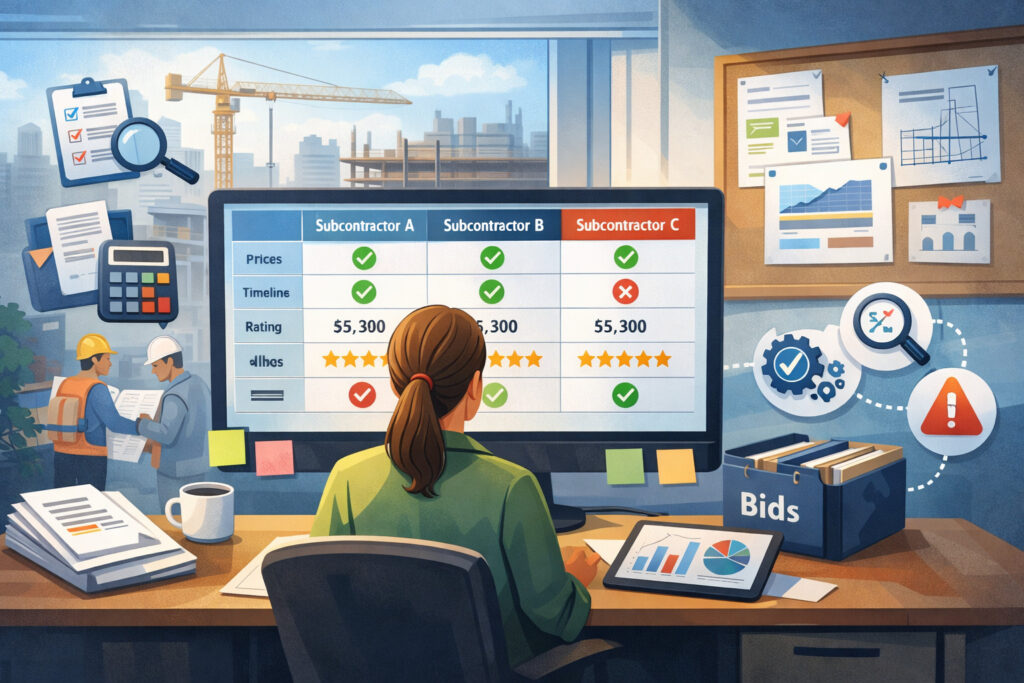
When you’re managing multiple trades, versions, addenda, and alternates, your system has to do two things:
- Let you find the right information fast
- Make comparisons fair and defensible
To organize and evaluate subcontractor bids, think in layers:
- Layer 1: Document control (what did they price, and when?)
- Layer 2: Scope control (what’s included/excluded, and what’s assumed?)
- Layer 3: Commercial control (price structure, unit rates, allowances, alternates)
- Layer 4: Performance control (capacity, history, risk profile)
Build a bid tracking rhythm (deadlines, log, follow-up)
Bid management falls apart when deadlines aren’t real and communication is scattered. Establish a rhythm:
- Invite date
- Questions due date
- Addenda issuance schedule
- Bid due date/time
- “Last call” reminder (24 hours)
- Bid receipt confirmation process
For bid deadlines and tracking, use one source of truth (a spreadsheet or software). Your log should include:
- Trade
- Company
- Contact
- Date invited
- Intent to bid (yes/no/maybe)
- Questions submitted (yes/no)
- Bid received (date/time)
- Addenda acknowledged (list)
- Notes (site visit, coverage gaps, constraints)
Short, consistent follow-up improves coverage without creating chaos.
Pro Tip: Call bidders early, not late. A five-minute scope walk-through call two weeks before bid day prevents twenty panicked calls on bid day.
Organize bids in folders the field team can actually use
Your structure should match how the project is managed:
- 00_Admin (bid instructions, addenda log, Q&A log)
- 01_Trade Packages (each trade has a folder)
- 01a_Scope Sheet
- 01b_RFQ/RFP Docs
- 01c_Bids Received
- 01d_Leveling & Clarifications
- 01e_Award Docs
If someone can’t find the awarded scope sheet in 30 seconds, your process will leak into the field as confusion.
Evaluate beyond price: scope alignment, schedule, and capacity
A thorough evaluation considers:
- Scope alignment: Do they carry everything on your scope sheet? Did they note clarifications that delete work?
- Exclusions/gaps: Are exclusions acceptable? Are they excluding common interfaces (firestopping, sleeves, testing)?
- Schedule commitments: Can they meet your start date and duration? Are they relying on overtime?
- Manpower: Do they have staffing to support your sequencing?
- Financial stability/references: Are they good payers to their vendors? Do they have a consistent performance history?
- Risk profile: Delegated design, long-lead equipment, specialty subs, access limitations
Price is only “low” if the scope and performance are real.
Subcontractor prequalification checklist (use before bid day)
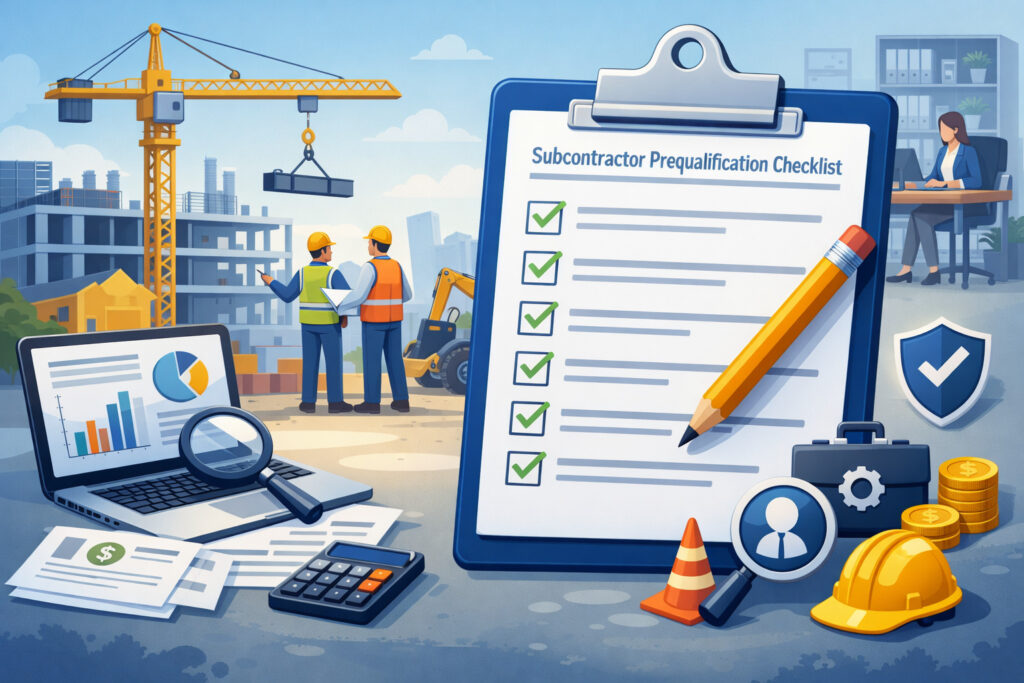
Prequalification isn’t about gatekeeping—it’s about avoiding avoidable failures. In 2026, many project problems start with a trade partner who simply can’t staff, procure, or manage the scope as planned. A lightweight prequel step saves time later.
Minimum prequalification criteria (baseline screen)
Use this checklist for subcontractor prequalification:
- Company license/registration (as applicable locally)
- Safety program overview and recent incident history
- Relevant project experience (similar size/complexity)
- Current backlog and capacity (what they’re actively building)
- Key personnel: PM/foreman resumes (or bios)
- Financial stability indicators (bank reference or letter, credit references, or internal scoring)
- Insurance and bonding verification
- Certificate of insurance (COI) meeting required limits
- Experience modification rate (if you track it locally)
- Bonding capacity letter (if bonds are required)
- References from recent GCs/owners
- Sub-tier plan (who they typically sub out, if any)
- Quality control approach (inspections, testing coordination, closeout readiness)
Keep it consistent: same questions, same scoring, every time. That builds a trade database you can trust.
Pro Tip: Ask “What jobs are you starting in the next 60 days?” Backlog alone doesn’t reveal staffing crunches—start dates do.
Prequalification scoring (simple and usable)
You don’t need a complex model. Use a 1–5 rating on:
- Safety
- Schedule performance
- Quality
- Communication/admin responsiveness
- Similar project experience
- Capacity/backlog fit
Then use notes: “Strong team, limited manpower,” “Great quality, slow paperwork,” etc. Your future self will thank you.
Bid leveling and comparison best practices (apples-to-apples every time)
Bid leveling is how you turn messy incoming quotes into a decision-ready comparison. It’s also where most teams either (a) do it well and avoid surprises, or (b) skip it and pay later through change orders and claims.
Clarify inclusions and exclusions before you touch the number
Start by extracting bid exclusions and clarifications into a single list. Many bids “look complete” until you read the clarifications. Common examples:
- Excluding permits, fees, testing
- Excluding temporary power/water or heaters
- Excluding lifts/scaffolding
- Excluding firestopping, sleeves, patching
- Excluding layout/field verification
- Excluding overtime, phasing, or off-hours work
- Excluding equipment startup/commissioning support
Your goal is to confirm whether exclusions are:
- Acceptable (owned by GC or another trade)
- Negotiable (sub can include for a price)
- Unacceptable (scope gap you cannot carry)
Then document the resolution. If you can’t explain to the field team who is responsible, the scope is not closed.
Pro Tip: Treat exclusions like scope bullets. If it’s excluded, assign it—either back into the sub’s scope, to another trade, or to the GC with a budget line.
Compare unit pricing and production assumptions (not just totals)
For many scopes, a lump sum hides risk. Pull out:
- Unit rates (per fixture, per linear foot, per SF, per device, per penetration)
- Hourly rates (T&M rates, foreman rates, crew rates)
- Overtime assumptions and shift premiums
- Material assumptions (brands, models, alternates)
A labor and material pricing review helps you catch:
- A low bid driven by unrealistic production rates
- A bid missing a major material package
- A bid assuming cheaper spec substitutions
- A bid assuming the GC provides equipment or temporary facilities
If a number is materially lower, your job is to find the reason—before awarding.
Evaluate alternates and value engineering proposals responsibly
Many subs will include alternates or value engineering proposals. Good. But they must be evaluated against:
- Spec compliance
- Owner expectations
- Schedule impact
- Warranty/maintenance implications
- Coordination complexity
Treat VE as a separate decision path: document the proposal, impacts, and approval workflow. Avoid “informal VE” that creeps into the base bid without anyone realizing it.
Adjust for scope gaps (leveling adjustments)
If a bid is missing scope you must carry, you have two choices:
- Add a leveling number (internal carry) to make comparisons fair
- Get the bidder to revise and include the scope
Either way, document it. Leveling adjustments should be transparent to the internal team so award decisions don’t get questioned later.
Sample bid comparison matrix (scope, price, exclusions, timeline, risk)
You don’t need fancy software to compare bids. You need a consistent matrix that forces you to look at the right things. Below is a sample bid comparison matrix you can recreate in a spreadsheet.
Sample matrix categories and scoring
Use these columns for a subcontractor bid comparison sheet:
- Bidder name
- Base price
- Scope compliance (Full / Partial / Needs clarification)
- Major exclusions (top 3–5)
- Clarifications (key assumptions)
- Addenda acknowledged (Y/N + list)
- Schedule (start date, duration)
- Manpower plan (crew size, peak manpower)
- Long-lead items (list + lead time plan)
- Risk rating (Low / Medium / High) with short reason
- Performance history (internal notes)
- Recommendation (Proceed / Clarify / No-bid)
Then add a short scoring system (1–5) for:
- Scope alignment
- Schedule confidence
- Capacity
- Admin responsiveness
- Past performance
Pro Tip: Don’t hide risk in narrative comments. Put a visible risk rating in the matrix so decision-makers can’t overlook it.
How to use the matrix in a real award meeting
In the award meeting, you should be able to answer:
- Why bidder A is higher (what’s included)
- Why bidder B is lower (what’s missing or assumed)
- What clarifications are still open
- What schedule risks exist for each bidder
- What your recommendation is and why
This turns the discussion from “who’s cheapest?” into “who’s the best fit for scope, schedule, and risk.”
Text-based sample bid tabulation layout (copy/paste friendly)
Here’s a simple bid tabulation template layout you can paste into notes or a spreadsheet. Adjust the fields to match your project.
Bidder 1: ____________________________
Phone/Email: ____________________________
- ________________________________________
- ________________________________________
- ________________________________________
Bidder 2: ____________________________
Phone/Email: ____________________________
- ________________________________________
- ________________________________________
- ________________________________________
Pro Tip: If you keep this structure consistent across trades, you can train new team members quickly and compare decisions across projects.
Common bid red flags (and exactly how to address them)
Bid red flags aren’t “gotchas.” They’re signals that you need clarification, validation, or a different trade partner. The key is to identify them early and address them consistently.
Red flag 1: Unrealistically low bid (the number doesn’t match the scope)
A low bid isn’t automatically bad, but it is automatically a question. Causes include:
- Missed scope items (they didn’t carry a drawing sheet, spec section, or interface)
- Wrong assumptions (they assumed fewer fixtures, shorter runs, less demolition)
- Underestimated labor (production rates too aggressive)
- Material substitution assumptions (not spec-compliant)
- Incomplete GC-provided items assumptions (equipment, temp power, access)
How to address it:
- Ask for a written scope confirmation against your scope sheet line-by-line
- Request a construction cost breakdown (labor vs material vs equipment vs sub-tier)
- Confirm schedule and manpower assumptions
- Require a revision if gaps are found
- If they can’t explain the number clearly, treat it as high risk
Pro Tip: “Help me understand your labor plan” is better than “Your bid is too low.” Keep it factual and scope-driven.
Red flag 2: Vague exclusions or “standard exclusions apply”
If a bid says “standard exclusions apply,” you don’t have a bid—you have a placeholder.
How to address it:
- Require a specific exclusions list
- Convert major assumptions into written clarifications
- Use your scope sheet to force alignment
- If they refuse to clarify, move them down the shortlist
Red flag 3: No addenda acknowledgment or inconsistent versioning
If they didn’t acknowledge addenda, they likely didn’t price the same job everyone else priced. That’s a fairness issue and a risk issue.
How to address it:
- Confirm which drawing/spec set they priced
- Require updated pricing with addenda included
- Document the revision and keep the old bid for reference only
Red flag 4: Aggressive schedule promises with no manpower plan
“I can meet your dates” means nothing without manpower and procurement planning. A bid that promises the world without detail often becomes a schedule claim later.
How to address it:
- Ask for crew size by phase and peak manpower
- Ask what work they’ll self-perform vs sub-tier
- Confirm long-lead items and release dates
- Validate access constraints and phasing
Red flag 5: Insurance/bonding is unclear or doesn’t meet requirements
This isn’t admin trivia. It’s job risk. If insurance or bonding is vague, you can end up with uncovered losses or a forced trade replacement midstream.
How to address it:
- Run insurance and bonding verification before award
- Confirm limits and endorsements match requirements
- Confirm bonding capacity and surety contact if applicable
- If they can’t comply, don’t assume it will “get fixed later”
Risk management during bidding (protect the project before it starts)
A clean bid process is one of your strongest risk controls. It’s cheaper to manage risk before award than after the subcontract is signed.
Incomplete scope and scope gaps (the most common source of change orders)
Scope gaps happen when:
- Interface responsibilities aren’t assigned
- Plans/specs contain conflicts
- Addenda changes aren’t carried consistently
- Trades exclude “coordination” items that are actually required
Risk control practices:
- Use a trade-specific scope sheet and require written acceptance
- Maintain a scope gap log and assign ownership
- Document scope of work (SOW) clarification outcomes
- Carry allowances only when truly unavoidable—and define how they convert
Supply chain and long-lead risks (procurement is part of bid evaluation)
Long-lead items aren’t just material issues—they affect sequencing, inspections, and commissioning. Treat long-lead planning as part of the bid.
Ask each bidder:
- What are your top long-lead items?
- What lead time are you carrying?
- When do you need approvals and releases?
- What alternatives are acceptable if lead times change?
Document those answers. Then the PM can manage procurement from day one.
Labor availability and staffing risk (capacity is not theoretical)
In 2026, labor availability can change quickly. Don’t assume a subcontractor can staff your job just because they want it.
Risk control practices:
- Ask what projects overlap with yours
- Confirm a foreman assignment expectation (even if tentative)
- Confirm peak manpower and where it comes from
- Watch for subcontractors who rely on heavy sub-tiering without clarity
Change order risk management starts in bid leveling
If you want to reduce change orders, don’t only look at price—look at the clarity of scope and the documentation trail.
- Convert verbal clarifications into written clarifications
- Attach clarifications to the award package
- Make sure the subcontract agreement references the same scope basis
Pro Tip: If your clarifications log isn’t attached to the subcontract, it doesn’t exist when the job gets stressful.
Tools and systems to improve bid efficiency (without overcomplicating it)
You can run an excellent bid process with a spreadsheet, disciplined folder structure, and consistent templates. Software can help, but it won’t fix a broken workflow.
Spreadsheets and bid tabs that actually work
A good bid tab spreadsheet should:
- Track invitations and bid receipt status
- Capture addenda acknowledgment
- Capture exclusions and clarifications in structured fields
- Support quick construction bid leveling adjustments
- Output a clean comparison view for decision-makers
Suggested spreadsheet tabs:
- Bidder list (by trade)
- Bid log (invite status, contacts, deadlines)
- Bid comparison (matrix)
- Clarifications log (questions, responses, resolution owner)
- Award tracker (selected sub, award date, required documents)
This is where your bid tabulation template earns its keep: it standardizes what “complete” looks like.
Construction management software (generic) as a workflow wrapper
Software helps most with:
- Centralized document distribution and access control
- Addenda/version control
- Bid receipt timestamping
- Standard forms and audit trails
- Communication logs
But the underlying rules still matter: one Q&A log, one package version, and clear scope sheets.
Centralized document tracking and version control for addenda
Addenda problems usually look like:
- Different bidders priced different versions
- Addenda content didn’t reach everyone
- Clarifications were handled verbally with only one bidder
Fix it with a simple protocol:
- Every addendum gets a number and date
- Every addendum gets logged in one place
- Every bidder must acknowledge it
- Every response is distributed to all bidders
Pro Tip: If you make one exception—one bidder gets a “quick call” answer—you just created an unfair process and a comparison problem.
Communication strategies that keep trades informed (and keep the process fair)
Good bid communication does two things: keeps the process moving, and protects fairness.
Set expectations early (instructions that reduce chaos)
Your bid invite should clearly state:
- Bid due date/time and submission method
- Questions due date/time
- Site visit rules (optional/mandatory)
- Addenda issuance method
- Required forms and insurance/bonding expectations
- Scope sheet must be included and signed/acknowledged
This prevents “I didn’t know” issues and reduces bid day phone calls.
Run a structured Q&A process (one log, one voice)
A structured Q&A workflow looks like this:
- All questions submitted to one email/form
- Questions logged with a unique ID
- Responses drafted by estimator/PM, validated by design team as needed
- Responses issued to all bidders
- If response changes scope, issue an addendum
This prevents favoritism and ensures the entire bid pool is pricing the same job.
Maintain transparency without giving away leverage
Fairness doesn’t mean oversharing internal strategy. It means consistent access to information that affects scope and pricing.
Good transparency:
- Scope clarifications issued to all bidders
- Addenda distributed to all bidders
- Clear deadlines and rules applied consistently
Avoid:
- Telling bidders competitors’ numbers
- Sharing internal budget targets
- Negotiating major scope changes with one bidder without re-leveling others
Negotiation and award phase (lock scope, lock schedule, then sign)
Award should feel boring—in a good way. If award feels rushed, you’re usually carrying unresolved scope questions into the field.
Final clarifications: turn assumptions into commitments
Before award, confirm:
- Full scope acceptance (scope sheet signed/acknowledged)
- Exclusions resolved (assigned or included)
- Schedule start and durations confirmed
- Long-lead release plan identified
- Closeout requirements understood (O&M manuals, as-builts, testing)
Convert the final clarifications into an award memo or clarifications exhibit.
Subcontract agreement negotiation (keep it aligned with bid basis)
Subcontract agreement negotiation should connect the final number to the final scope basis. Key practices:
- Reference the exact drawings/specs/addenda set
- Attach the scope sheet and clarifications log
- Define alternates and unit pricing clearly
- Define change order process and documentation
- Confirm payment terms, retainage (if used locally), and schedule requirements
Your goal is to avoid the classic problem: the subcontract says one thing, the bid clarifications say another, and the field team is stuck in the middle.
Documenting commitments (so the field can execute)
The award package should include:
- Award letter or notice to proceed (as applicable)
- Final price breakdown and alternates accepted/rejected
- Scope sheet + clarifications/exclusions resolution
- Schedule commitments and constraints
- Certificates for insurance and bonding evidence
- Key contacts and escalation path
Pro Tip: If the foreman can’t see what was clarified, they will build based on assumptions. That’s how disputes start.
Common mistakes to avoid when managing subcontractor bids
Most bid problems come from predictable mistakes. Avoid these and your process improves immediately.
Awarding solely on lowest price (and ignoring risk)
The lowest price can be the right choice—if scope and capacity are real. But awarding on price alone ignores:
- Scope gaps hidden in exclusions
- Weak schedule commitment
- Poor coordination history
- Insurance/bonding issues
- Inexperienced sub-tier structure
A better rule: “Lowest complete and confirmed bid from a capable performer.”
Failing to document scope clarifications
Verbal clarifications disappear the moment the project gets stressed. If it’s not written and attached, it’s not enforceable in practice.
Use a clarifications log and attach it to the award.
Ignoring subcontractor performance history
Past performance isn’t gossip—it’s data. Track:
- Schedule hits/misses
- Quality issues and punchlist duration
- Change order patterns
- Responsiveness
- Documentation quality
This subcontractor performance history should influence shortlist decisions.
Poor addenda tracking and version control
If your addenda tracking is messy, your comparisons are invalid. Keep one log, require acknowledgments, and don’t accept “we assumed.”
Rushed award decisions without internal alignment
The award requires alignment between estimating, operations, and leadership. If the PM doesn’t understand what was carried, you’ll see scope disputes immediately.
30/60/90-day bid process improvement roadmap (practical upgrades)
If your current process is inconsistent, fix it in stages. The goal is not perfection—it’s repeatability.
First 30 days: standardize templates and checklists
Focus on high-impact standardization:
- Standard trade scope sheet template
- Standard bid invite email template
- Standard Q&A log template
- Standard bid tabulation template
- Standard award package checklist
Train the team on one “expected” workflow. Consistency reduces errors.
Pro Tip: Standardize the inputs (scope sheets, bid forms) before you try to standardize the outputs (comparison reports).
Next 60 days: build prequalification and refine the trade database
In month two, upgrade your trade network:
- Implement a basic prequal questionnaire
- Score subs consistently (1–5 categories)
- Segment trade partners:
- Preferred (trusted performers)
- Approved (can bid)
- Conditional (only with additional controls)
- Update contacts and roles (estimating vs operations)
- Track bid participation rates and responsiveness
This improves bid coverage and reduces “unknown bidder” risk.
Next 90 days: performance tracking and post-bid reviews
Month three is where you build learning loops:
- Post-bid review after each award:
- What scope gaps appeared?
- What addenda created confusion?
- Which clarifications took the longest?
- What would we change in the scope sheet?
- Start performance tracking on awarded subs:
- Schedule reliability
- Quality/punchlist closeout
- Change order behavior
- Documentation quality
Over time, this becomes your internal advantage: fewer surprises, better trade partners, and faster decisions.
FAQs
Q1) What is the construction subcontractor bid process?
Answer: The construction subcontractor bid process is the workflow a general contractor uses to define scope, invite qualified trade contractors, manage questions and addenda, collect bids, level them for apples-to-apples comparison, negotiate final terms, and award the subcontract.
A strong process includes clear scope sheets, a structured RFQ/RFP package, consistent communication, and documented clarifications tied to the final contract award process.
Q2) How do I compare subcontractor bids fairly?
Answer: Compare bids fairly by leveling them to the same scope basis. Start with scope alignment and addenda acknowledgment, then review exclusions, clarifications, unit pricing, schedule commitments, and manpower capacity. Use a subcontractor bid comparison sheet so every bidder is evaluated on the same criteria, not just the bottom-line number.
Q3) What is bid leveling in construction?
Answer: Bid leveling (often called construction bid leveling) is the method of adjusting and comparing subcontractor bids so they reflect the same scope and assumptions.
It includes identifying gaps, clarifying inclusions/exclusions, normalizing alternates and allowances, and documenting any internal adders for missing scope so decision-makers understand true cost and risk.
Q4) Should I always choose the lowest bid?
Answer: No. The lowest bid can be the best choice only if it’s complete, aligned with scope, and backed by a subcontractor with the capacity and track record to perform. If a low bid relies on exclusions, unclear assumptions, or unrealistic staffing, it can create schedule delays and change order risk management problems later.
Q5) How do I handle bid exclusions?
Answer: First, list all bid exclusions and clarifications in a single log. Then decide whether each exclusion is acceptable, negotiable, or unacceptable. If it creates a scope gap, assign ownership (sub, GC, or another trade) and document the resolution in writing. Attach the resolved clarifications to the award package and subcontract.
Q6) What documents should I request from subcontractors during bidding?
Answer: At minimum request: bid form with price breakdown, exclusions/clarifications list, addenda acknowledgment, proposed schedule and manpower plan, unit rates (if relevant), insurance certificate requirements outline, bonding capacity letter if required, references, and a short description of similar projects. For higher-risk scopes, request a procurement plan for long-lead items and key staff assignments.
Q7) How can I prevent scope gaps?
Answer: Prevent scope gaps by using trade-specific scope sheets, running a structured Q&A process, and documenting scope of work (SOW) clarification in writing.
During leveling, compare bids line-by-line against the scope sheet, and explicitly assign interface responsibilities like sleeves, embeds, firestopping, scanning, layout, and testing coordination.
Q8) How do I verify subcontractor insurance and bonding?
Answer: Require insurance and bonding verification before award. Review certificates for required limits and endorsements, confirm coverage dates align with the project, and verify bonding capacity (if bonds are required) through a capacity letter or surety contact. If documentation is unclear or incomplete, treat it as a risk issue—not a paperwork issue.
Q9) What’s the best way to track multiple bids?
Answer: Use one centralized bid log and one version-controlled document repository. Track invitations, intent-to-bid, questions, addenda acknowledgments, bid receipt timestamps, exclusions, and clarifications. A spreadsheet-based bid tabulation template can work well if it’s consistent and shared with the team.
Q10) How can I improve subcontractor bid management efficiency?
Answer: Standardize your templates (scope sheets, bid forms, Q&A log, award checklist), refine your prequalification workflow, and build a trade database with performance notes. Then add a post-bid review process to capture lessons learned. Over time, you’ll reduce rework, improve bid quality, and speed up decision-making without sacrificing fairness.
Q11) What should be included in a subcontractor bid comparison sheet?
Answer: Include bidder name, base price, alternates, allowances, addenda acknowledged, major exclusions, key clarifications, schedule and manpower plan, long-lead risks, performance history notes, and a risk rating. The goal is to make scope, schedule, and risk visible—not hidden in email threads.
Q12) How do I evaluate value engineering proposals from subcontractors?
Answer: Treat VE proposals as separate from the base bid. Require the subcontractor to describe the change, compliance impact, schedule impact, and any warranty/maintenance considerations. Review with the design team and operations before accepting. Document acceptance formally so it doesn’t become an informal scope change later.
Q13) What are common causes of change orders related to bidding?
Answer: Common causes include incomplete scope definition, missed addenda, unclear exclusions, unassigned interface responsibilities, unrealistic schedule assumptions, and failure to document clarifications in the subcontract. Strong change order risk management starts with clear scope sheets and disciplined bid leveling.
Q14) How do I manage bid deadlines without hurting trade relationships?
Answer: Set deadlines clearly, provide complete bid packages early, and maintain a predictable addenda/Q&A rhythm. Remind bidders 24 hours before due time and confirm receipt. Fairness and clarity matter more to good trade partners than last-minute pressure tactics.
Q15) What is the contract award process for subcontractors?
Answer: The contract award process includes final scope and price confirmation, resolution of exclusions and clarifications, schedule confirmation, verification of insurance/bonding requirements, internal approval, issuance of the award notice, and execution of the subcontract agreement with all exhibits attached (scope sheet, addenda list, clarifications log, and pricing breakdown).
Conclusion
If you want fewer surprises in the field, start by tightening how you manage subcontractor bids. The best teams don’t rely on memory or personality—they rely on a repeatable system: clear scope, disciplined communication, clean bid leveling, and documented commitments.
When you consistently organize and evaluate subcontractor bids, you protect cost and schedule, reduce disputes, and build stronger relationships with trade partners who appreciate a fair, organized process.
That’s what makes managing subcontractor bids in construction projects sustainable—especially when projects move fast and conditions change.