How to Create a Construction Budget That Works
A construction budget is more than a number you hope to hit. It’s a decision-making system that tells you what you can afford, when you’ll spend it, and how you’ll control it when reality changes.
A construction budget that works is detailed enough to prevent surprises, flexible enough to absorb change orders, and structured enough to support financing, bidding, procurement, and progress billing.
Many projects “go over budget” because the original construction budget wasn’t built on the same assumptions used in the field. Labor hours were guessed, production rates were unrealistic, allowances were vague, scope gaps were hidden, and contingency was treated like “extra profit” instead of risk coverage.
A working construction budget avoids those traps by linking scope, quantities, costs, schedule, and contract strategy into one clear plan.
This guide walks through a step-by-step approach used by owners, general contractors, and project managers to build a construction budget that holds up from preconstruction to closeout. You’ll learn how to separate hard costs and soft costs, choose the right estimate type, structure line items, price labor and materials accurately, plan cash flow, and control changes.
You’ll also see how modern tools like BIM-based takeoffs and cost databases are changing construction budgeting—and what future construction budget workflows may look like.
Define the Budget’s Purpose, Audience, and Level of Detail
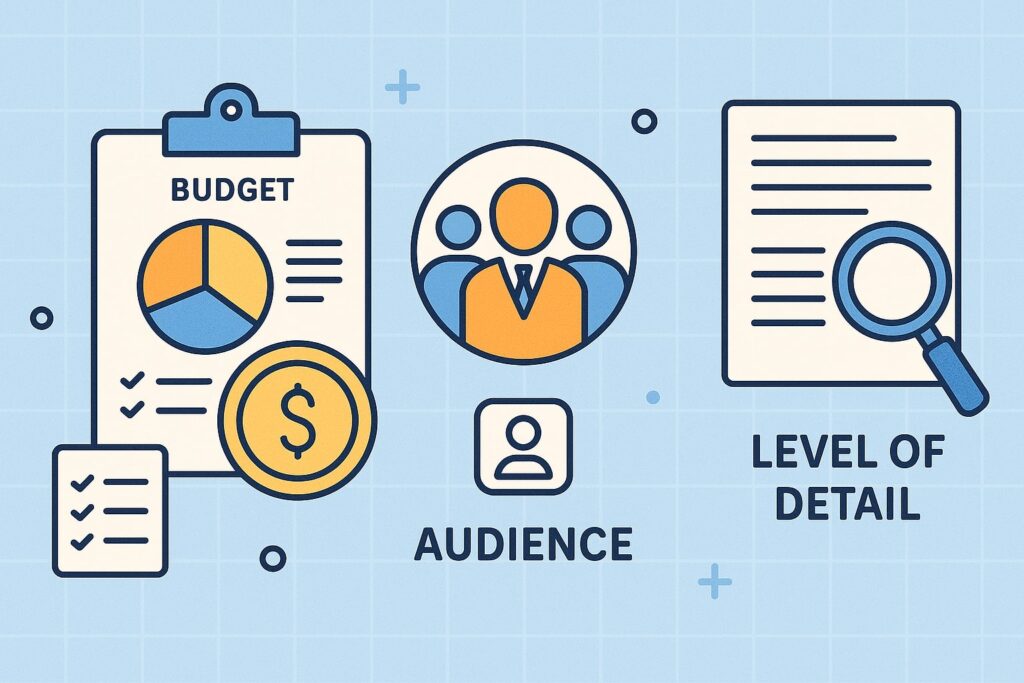
A construction budget should be built for a specific purpose, because the purpose determines the format and the level of detail.
A high-level owner’s cost estimate used to decide whether to build is not the same as a contractor’s construction budget used to buy materials and manage subcontractors. When teams skip this step, they produce a budget that looks polished but fails in the field.
Start by naming the audience. Is the construction budget for an owner, a lender, an architect, a general contractor, or an internal leadership team?
Owners and lenders want clarity around total project cost, soft costs, contingency, and draw timing. A general contractor needs trade-level line items, production assumptions, and a schedule of values. A project manager needs a construction budget that supports procurement, change control, and forecasting.
Next, pick the detail level. If you’re still early in design, you may use a conceptual construction budget with major categories and allowances. As drawings mature, the cost estimate should shift into a quantity-based estimate with specific line items and subcontract scopes.
The construction budget becomes more reliable as the scope becomes more defined—but only if you document assumptions and update the budget when scope changes.
Finally, define success. A cost estimate that works is one that is understandable, trackable, and defensible.
If someone asks, “Why is drywall this number?” you should be able to explain the takeoff quantity, the labor production rate, material pricing, waste factor, overhead, and contingency logic. That’s what turns a construction budget into a real management tool rather than a spreadsheet of wishes.
Clarify the Estimate Stage You’re In
A construction budget changes shape as the project progresses. Early budgets are directional; later budgets are contractual and operational. If you treat a conceptual cost estimate like a guaranteed price, you’ll set expectations you can’t meet.
Common stages include order-of-magnitude estimates (early feasibility), schematic estimates, design development estimates, and construction document estimates. Each stage should tighten the range of uncertainty.
If your construction budget is still early-stage, use ranges and explicitly add larger contingency. If you’re near bid-ready drawings, your project cost should be trade-level and supported by takeoffs and vendor quotes.
Decide How You’ll Track Costs Against the Budget
Before you build the construction budget, decide how you’ll track actual costs. Your cost coding structure should match your accounting system and your project management workflow. If the project cost is organized one way and invoices are coded another way, cost control becomes a manual mess—and mistakes hide overruns until it’s too late.
A working construction budget aligns with cost codes, purchase orders, subcontract schedules, and progress billing. It also includes “control accounts” for major cost drivers like concrete, steel, MEP, and finishes so you can forecast accurately.
Gather the Right Inputs Before You Start Pricing Anything

A construction budget fails when it’s built on incomplete inputs. Budgeting is not just math; it’s scope understanding. Before you assign dollars, collect the documents and decisions that define what you’re actually building.
Start with the latest drawings and specifications, even if they’re not final. Add geotechnical reports, survey information, utility notes, and any civil plans.
Site conditions drive major construction budget swings—excavation, unsuitable soil, dewatering, rock, access constraints, and utility relocation. If those are unknown, your project cost must include explicit allowances and contingency.
Next, gather owner decisions and “basis of design” information. Finishes, equipment selections, performance requirements, and sustainability goals all affect the construction budget.
A simple example: choosing premium windows or a high-efficiency HVAC system can materially change cost and lead times. If selections are not decided, your construction budget should include allowances with a clear definition of what is included.
Also collect commercial inputs: delivery method (design-bid-build, design-build, CM-at-risk), contract type (lump sum, GMP, cost-plus), procurement strategy, and schedule targets. The construction budget is highly sensitive to schedule. Overtime, acceleration, temporary conditions, and long-lead expediting can inflate costs quickly.
Most importantly, document assumptions. A construction budget that works includes written assumptions for scope boundaries, quantities, waste, labor rates, escalation, and exclusions. When change orders appear later, assumptions are your protection and your roadmap.
Create a Scope Checklist to Prevent Gaps
Scope gaps are one of the most expensive construction budget problems. Use a checklist that covers sitework, utilities, structural, envelope, interior, MEP, fire protection, technology, security, and closeout items. Include testing, inspections, permits, and temporary requirements.
The checklist should also cover “gray areas” like demolition, hazardous materials, shoring, traffic control, and tie-ins. These items often fall between trades unless the construction budget clearly assigns responsibility.
Confirm Local Constraints That Affect Cost
Even without naming a country, projects are influenced by local labor availability, wage requirements, union conditions, permitting timelines, inspections, and code requirements. These factors can change the construction budget as much as material prices.
If your project is in a dense urban zone, logistics and staging become major budget items. If it’s in a remote area, mobilization and per diem may increase. A realistic construction budget respects location-specific constraints.
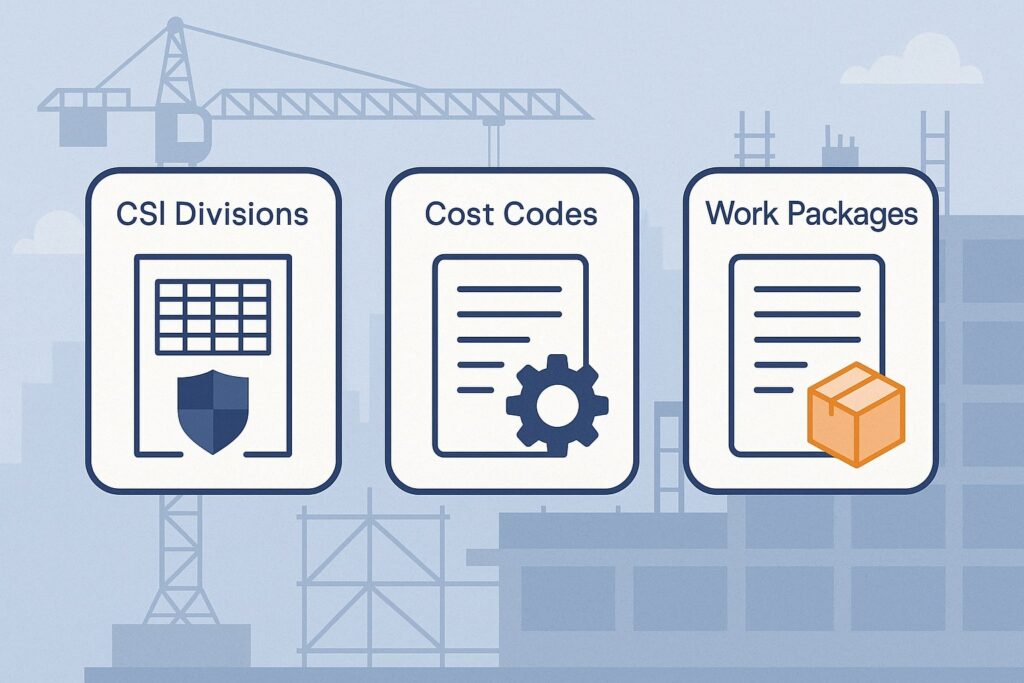
Choose the Right Budget Structure: CSI Divisions vs. Cost Codes vs. Work Packages
The structure of your construction budget determines whether you can manage it. If the budget categories are too broad, you can’t see overruns early. If they’re too granular, you’ll drown in line items and lose clarity. A construction budget that works sits in the middle: detailed enough for control, simple enough for decisions.
Many teams structure a construction budget using CSI MasterFormat divisions (Division 01 through Division 33). This is useful for aligning with specifications and trade scopes. Owners often like this format because it’s standardized and familiar.
Contractors may prefer internal cost codes that match accounting and field reporting. Cost codes can be more operational, grouping work by how it’s purchased and installed.
For example, “concrete” might be split into foundations, slab-on-grade, elevated slabs, and misc concrete. A construction budget with cost codes supports forecasting because each code maps to purchase orders, subcontracts, and daily production.
Another approach is work packages. A work-package construction budget groups costs by procurement packages: sitework package, structural package, envelope package, MEP rough-in, interiors, and so on. This helps with bidding and procurement timing, and it’s especially useful in design-build.
No matter the structure, keep consistency. Don’t change categories mid-project unless you also re-map historical costs. A working construction budget remains stable so reports stay meaningful from month to month.
Build Line Items That Match How You’ll Buy the Work
The best construction budget mirrors procurement. If you will subcontract roofing as one package, create a budget line that matches that scope. If you’ll self-perform carpentry, break line items into manageable control accounts: framing labor, materials, hardware, and equipment.
When a construction budget is aligned with purchasing, you can compare bids to budget line-by-line. You can also lock costs earlier by awarding packages strategically.
Include “Division 01” as a Real Cost Driver
General requirements (often called Division 01) is where many construction budget overruns hide. Temporary utilities, dumpsters, safety, site fencing, trailers, project management staff, cleaning, and protection are real costs. Treating these as a vague percentage causes under-budgeting and painful corrections later.
A construction budget that works lists general conditions clearly, including duration assumptions, staffing plan, and temporary facilities.
Separate Hard Costs, Soft Costs, and Owner Costs the Right Way
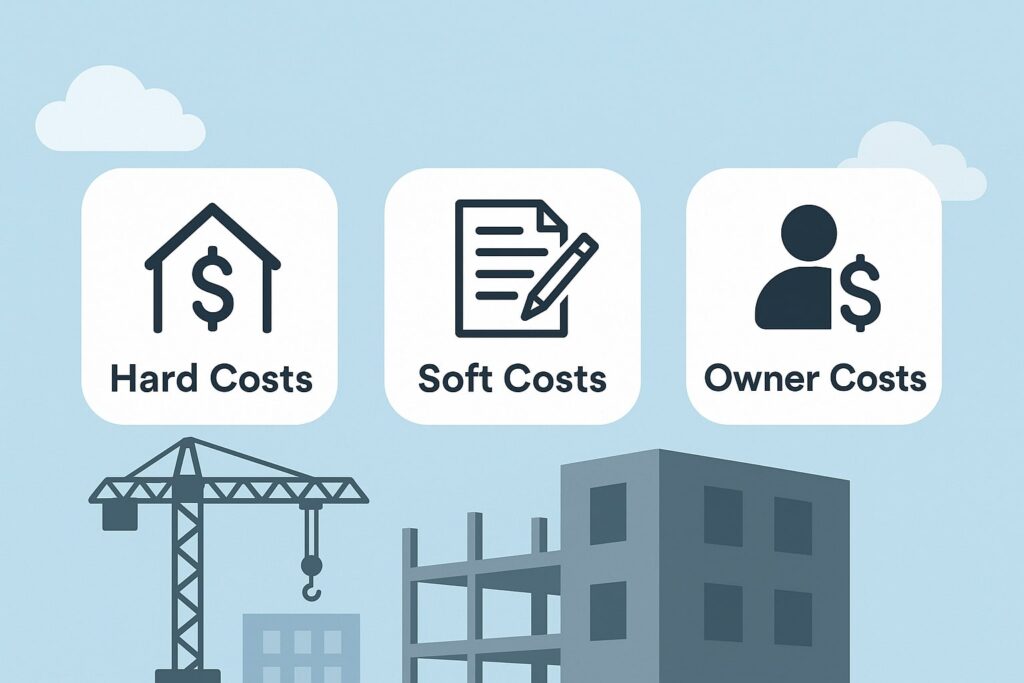
A common budgeting mistake is mixing categories until the “construction budget” becomes unclear. For project clarity, separate hard costs (direct construction), soft costs (professional services and fees), and owner costs (items purchased directly by the owner).
Hard costs include labor, materials, equipment, subcontractor work, general conditions, and contractor overhead and profit (depending on contract type).
Soft costs include design fees, engineering, permitting, legal, insurance, financing fees, and sometimes commissioning. Owner costs may include furniture, fixtures, and equipment (FF&E), IT systems, specialty equipment, and tenant improvements depending on the project type.
This separation matters because different costs follow different timelines. Soft costs often occur earlier. Owner purchases may be paid directly and not flow through construction pay applications.
Lenders may require a particular construction budget format with separate contingencies. If you don’t separate these costs, you can have cash flow issues even when the total construction budget looks fine.
Also be careful with allowances. An allowance is not free money—it’s a placeholder for an undefined selection. A construction budget that works defines allowances by quality level, quantity, and what is included (install, tax, freight, and contractor markup). Otherwise, allowances become instant change orders.
Define What “Total Project Cost” Includes
Many people say “construction budget” when they mean “total project cost.” They are not the same. Total project cost includes land (if applicable), soft costs, financing, owner costs, and sometimes operating reserves. A construction budget usually refers to the building and site construction portion.
Clarify which number you are presenting. If stakeholders think the construction budget includes everything but it doesn’t, trust breaks and approvals get delayed.
Handle Owner-Furnished, Contractor-Installed Items Correctly
Owner-furnished, contractor-installed (OFCI) items can wreck a construction budget if not managed. The owner buys the item, but the contractor still has costs: receiving, storage, handling, installation labor, coordination, and sometimes warranty responsibility.
A construction budget that works includes line items for OFCI installation and coordination. It also accounts for schedule risk if the owner’s delivery date slips.
Build Accurate Quantities: Takeoffs, Waste Factors, and Scope Boundaries
Quantities are the backbone of a reliable construction budget. If quantities are wrong, pricing perfection won’t save you. The goal is not just to count items, but to count them with the same scope boundaries the field will use.
Start with a takeoff process that is repeatable. Use drawings, specifications, and detailed callouts. Define measurement rules: gross vs. net, deduct openings or not, include overage or not, and how you treat thickness changes. A construction budget that works uses consistent measurement rules so comparisons remain meaningful.
Add waste factors intelligently. Waste is not one number across all materials. Drywall, tile, flooring, roofing, conduit, and rebar all have different waste patterns. Waste depends on layout complexity, packaging sizes, and crew skill. The construction budget should include waste that reflects reality, not hope.
Also define scope boundaries. For example, is framing line item including blocking? Are penetrations included in firestopping? Who provides sleeves and embeds?
These boundary decisions determine whether costs appear once or are missed entirely. A working construction budget documents boundaries so bids can be compared fairly.
Use Historical Data, but Don’t Copy-Paste Blindly
Historical projects are valuable for benchmarking. But copying a past construction budget without adjusting for size, complexity, schedule, location constraints, and market conditions is risky.
Use historical data to sanity-check quantities and unit rates. Then validate with current takeoffs and vendor input. A construction budget that works uses history as a guide, not as a shortcut.
Consider BIM-Based Quantity Takeoffs Where It Makes Sense
5D BIM (model-based quantity and cost) is increasingly used to support construction budgeting. It can improve speed and consistency, especially on complex projects. But model-based takeoffs are only as accurate as the model’s level of detail.
If you use BIM quantities, validate them against 2D drawings and field scope. A construction budget that works treats BIM as an accelerator—not a replacement for professional judgment.
Price Labor Correctly: Production Rates, Burden, and Crew Mix
Labor is often the biggest variable in a construction budget. Material pricing can be quoted, but labor depends on productivity, site conditions, coordination, weather, rework, inspections, and schedule pressure. To build a construction budget that works, you must price labor using realistic production rates and fully loaded labor costs.
Start with a base hourly wage and add labor burden: payroll taxes, insurance, benefits, paid time off, training, small tools, and sometimes union benefits or dues. Many budgets understate labor because they use wage only, not fully burdened cost. Your construction budget should reflect the actual hourly cost to put a person on site.
Then set production rates. Production is “units per hour” or “hours per unit.” Use rates from your own history when possible. Adjust for project conditions: ceiling height, access, congestion, work at night, extreme temperatures, or a tight schedule. If the schedule is aggressive, labor efficiency drops due to stacking trades and overtime.
Crew mix matters too. A crew is not “one person.” For many tasks you need a lead, helpers, equipment operators, or specialized trades. A construction budget that works reflects the crew that will actually perform the work and includes supervision and layout time.
Account for Overtime and Acceleration Honestly
Overtime is not linear. Paying time-and-a-half doesn’t buy time-and-a-half productivity. Fatigue, rework, and coordination friction reduce efficiency.
If your schedule requires overtime, your construction budget should include overtime premiums and reduced productivity. Under-budgeted overtime is a common reason budgets “mysteriously” fail late in a project.
Include Field Supervision and Project Management Time
Field supervision is sometimes hidden in overhead when it should be a visible cost. A construction budget that works includes superintendent time, safety management, quality control, and project engineering—especially on complex projects.
If you’re managing multiple subs, the coordination workload is real. Ignoring it creates budget strain and weakens cost control.
Price Materials and Equipment: Quotes, Lead Times, and Escalation
Materials and equipment pricing has become more volatile in recent years, and that volatility directly impacts a construction budget. A budget that works relies on real quotes for major packages, not generic unit costs pulled from old spreadsheets.
Start by identifying “high-impact” materials: steel, concrete, lumber, roofing, glazing, mechanical equipment, electrical gear, and specialty finishes. Get vendor quotes early, even if design is not final.
Use those quotes to build allowances with realistic scope and clarify what is included: delivery, fuel surcharges, taxes, storage, and installation accessories.
Lead times also belong in the construction budget conversation because schedule risk becomes cost risk. Long-lead items may require early release deposits, storage, and expediting. If procurement is delayed, you may pay more or face substitution costs.
Escalation is another key factor. If the project schedule runs many months, pricing may change. A construction budget that works includes an escalation assumption and explains it. You can manage escalation through early procurement, locked pricing, or contract language—but you can’t manage what you didn’t acknowledge.
Build a Quote Log and Tie It to Budget Line Items
A quote log tracks vendor, scope, date, validity period, exclusions, and alternates. This makes your construction budget defensible. If someone challenges a number, you can show the quote source and assumptions.
Also track quote expirations. A construction budget that works is maintained, not “set and forget.” Quotes become stale, and stale quotes become overruns.
Plan for Substitutions Without Losing Budget Control
Value engineering and substitutions are normal. But substitution decisions can create hidden costs: added labor, coordination, warranty complexity, or long-term maintenance issues.
When you approve a substitution, update the construction budget and document the change. A working construction budget stays aligned with what will actually be built.
Add Contingency the Right Way: Design, Construction, and Owner Risk
Contingency is not a slush fund. It is planned risk coverage. A construction budget that works uses contingency as a tool to absorb uncertainty, not as an afterthought.
There are different contingency types. Design contingency covers incomplete design and scope evolution. Construction contingency covers execution risk: unforeseen conditions, productivity variability, coordination challenges, and minor scope clarifications.
Owner contingency covers owner-driven changes and scope upgrades. If you lump all of these into one bucket, you lose visibility and decision discipline.
The right contingency amount depends on project stage and risk profile. Early conceptual construction budgets typically require higher contingency because scope is less defined.
As design matures and bids are received, contingency can be adjusted downward—but never eliminated. Even with perfect drawings, field conditions and coordination produce real risk.
A working construction budget also defines “rules of use.” Who can spend contingency? What approvals are needed? When contingency is used, does it become a budget transfer to a cost code, or does it stay in a reserve? Clear rules prevent the slow bleed that causes late-project panic.
Identify Specific Risks and Quantify Them
Instead of guessing contingency, list risks and assign rough cost impacts. Examples include poor soils, utility conflicts, long-lead equipment delays, material price increases, permitting delays, or weather impacts.
Even if your numbers are approximate, the exercise improves construction budget realism. It also helps stakeholders understand what the contingency is protecting.
Don’t Confuse Contingency With Allowances
Allowances are for known-but-undefined selections. Contingency is for unknowns and risks. If you use contingency to cover missing scope, your construction budget is not complete.
A construction budget that works includes both: defined allowances for undecided items and contingency for risk.
Build a Cash Flow Plan That Matches the Construction Schedule
A construction budget can be “right” and still fail if cash flow is wrong. Cash flow is about timing: when costs occur versus when funds are available. A working construction budget supports project financing, progress billing, and vendor payment schedules.
Start with the project schedule. Map major work phases—sitework, foundations, structure, envelope, MEP rough-in, interiors, finishes, commissioning—then distribute budget costs across the timeline. This becomes a cash flow curve that forecasts monthly spending.
Next, consider payment terms. Subcontractors may require deposits, mobilization payments, or stored materials billing. Long-lead equipment may require a large down payment and milestone payments before delivery. Your construction budget should reflect these realities so you don’t run short on cash mid-project.
Also consider retainage, if applicable. Retainage reduces payments to contractors and subs until milestones or closeout. This affects cash flow for both parties. If you ignore retainage impacts, you may misjudge how much working capital you’ll need.
A construction budget that works also anticipates end-of-project costs that arrive late: punch list labor, commissioning, testing, training, closeout documents, and final cleaning. Many budgets overspend early and starve closeout, which delays completion and increases overhead.
Create a Schedule of Values That Supports Billing and Control
A schedule of values (SOV) is the breakdown used for progress billing. If the SOV is too broad, you can’t track progress accurately. If it’s too granular, billing becomes slow and disputed.
Align the SOV with your construction budget categories and major procurement packages. A working construction budget makes billing predictable and reduces friction with stakeholders.
Plan for Change Orders in Cash Flow
Change orders affect timing as much as total cost. If a change is approved but not funded quickly, contractors may slow work or carry unpaid costs.
A construction budget that works includes a process for pricing, approval, and funding changes—and reflects expected timing in cash flow forecasts.
Control the Budget During Construction: Commitments, Forecasting, and Variance Reports
The real test of a construction budget is not how it looks on day one, but how it performs under pressure. Budget control requires three layers: committed costs, actual costs, and forecast-to-complete.
Committed costs include awarded subcontracts and purchase orders. Actual costs include paid invoices and payroll. Forecast-to-complete includes what you expect to spend for remaining work, including known risks and pending changes.
If you only track actual costs, you’ll discover problems late. A construction budget that works relies on forecasting.
Set up a cadence for budget reviews—weekly internally and monthly with stakeholders. Use variance reporting: budget vs. commitments vs. actuals vs. forecast.
Investigate variances early. If concrete comes in 8% high, don’t wait until the foundation is finished to react. Early action might include negotiating scope, adjusting sequencing, revisiting allowances, or value engineering.
Also manage commitments proactively. Don’t wait until late to buy long-lead materials. Lock pricing where possible, but only after scope is clear. Procurement planning is budget control.
Finally, keep your budget “clean.” When you move money between line items, document why. When you use contingency, transfer it to the impacted cost code so reports remain honest. A working construction budget is transparent—even when the news is uncomfortable.
Use a Simple Forecasting Method if You’re Not Using Software
You don’t need expensive software to forecast. For each line item, track:
- Original construction budget amount
- Committed amount (contracts/POs)
- Actual spent to date
- Estimated cost to complete
- Forecast final cost
This structure makes overruns visible early. It also supports conversations based on facts, not feelings.
Watch These Common Budget Leak Points
Some categories consistently leak: general conditions (duration creep), MEP coordination (rework), finish selections (upgrades), sitework surprises, and closeout/punch list labor.
A construction budget that works monitors these areas with extra attention and maintains stronger documentation.
Manage Change Orders Without Letting Them Destroy the Budget
Change orders are inevitable. The question is whether your construction budget absorbs them in a controlled way or gets overwhelmed. A working construction budget includes a change management system from the start.
First, classify changes. Is it owner-driven scope growth, design clarification, unforeseen conditions, or contractor error? The classification affects who pays and how contingency is used. Without classification, every change becomes a negotiation and damages relationships.
Next, price changes consistently. Use the same labor burden, production assumptions, markups, and documentation rules you used for the original construction budget. Require backup: takeoffs, quotes, and time impacts. Approving poorly defined changes creates compounding budget errors.
Also manage time impacts. Many change orders increase project duration. Duration increases general conditions, staff costs, temporary utilities, and sometimes financing costs. A construction budget that works accounts for time-related impacts, not just material and labor.
Finally, update the budget immediately when changes are approved. Don’t keep “shadow budgets” in emails. Your construction budget should be the single source of truth, showing original budget, approved changes, revised budget, and forecast.
Set Approval Thresholds and a Clear Workflow
Define who can approve changes and at what dollar value. Small field changes can be approved quickly, but large changes should go through formal review.
A construction budget that works balances speed and control. Slow approvals cause schedule risk; uncontrolled approvals cause cost risk.
Keep a “Potential Change Order” Log
Track pending changes before they are approved. This helps forecasting because you can estimate the likely impact on the construction budget even before paperwork is final.
A strong potential change order log reduces surprises and supports better decisions.
Build in Quality, Safety, and Compliance Costs Upfront
Some budgets fail because they treat quality and safety as “free.” They are not free. A construction budget that works includes the cost of doing things correctly: inspections, testing, supervision, safety measures, training, and compliance documentation.
Quality costs include special inspections, material testing, mockups, commissioning, and third-party reviews. Safety costs include safety personnel, PPE, signage, fall protection systems, training, and sometimes site-specific safety requirements. Compliance may include environmental controls, stormwater management, dust control, and reporting.
If these costs are omitted, they appear later as “unexpected” expenses and get paid from contingency or margin. That weakens the construction budget and invites shortcuts—which can create rework and claims that cost far more.
Budgeting these items upfront also improves project outcomes. When crews have the right resources, productivity improves and rework declines. In many cases, a construction budget that includes proper quality control is actually more predictable and less expensive in the long run.
Include Closeout Requirements as Real Budget Items
Closeout often includes as-built documentation, O&M manuals, training, warranties, testing reports, punch list work, final cleaning, and demobilization.
A working construction budget includes these costs explicitly so the project finishes strong rather than limping across the line.
Technology and Future Trends in Construction Budgeting
Construction budgeting is evolving quickly. While the basics remain the same—scope, quantities, costs, and control—the tools and expectations are changing. A construction budget that works today should also anticipate what’s becoming standard.
One major trend is real-time cost data. More teams are linking supplier pricing, subcontractor bids, and historical job costs into dashboards that update forecasts automatically. This reduces the lag between “cost change” and “budget awareness.”
Another trend is model-based estimating. As BIM models become more detailed, budgets can be tied to building components, improving takeoff speed and consistency.
Over time, this supports scenario planning: “What happens to the construction budget if we change the façade system?” That kind of rapid iteration helps teams value-engineer earlier, when changes are cheaper.
Artificial intelligence is also entering estimating workflows. AI tools can assist with quantity extraction, scope gap detection, and bid leveling. The most useful future prediction is not that AI will replace estimators, but that it will reduce repetitive work and improve risk identification.
The construction budget of the near future will likely be more continuously updated rather than rebuilt in large, manual cycles.
Finally, sustainability and carbon reporting may become more integrated. Owners increasingly want cost and environmental impact visibility. This can influence material choices, procurement strategy, and lifecycle cost thinking—all of which affect the construction budget.
What to Do Now to Stay Ahead
If you want your construction budget process to stay competitive, start by standardizing cost codes, building a clean historical cost database, and improving your takeoff consistency. Then adopt tools that reduce friction: digital takeoff, quote logs, and forecasting dashboards.
A construction budget that works is not just “accurate”—it is fast to update, easy to explain, and resilient under change.
FAQs
Q.1: What is the most important rule for a construction budget that works?
Answer: The most important rule is to connect scope to cost with documented assumptions. A construction budget works when every major number can be explained by quantities, unit rates, quotes, labor assumptions, and scope boundaries.
If a budget line item exists without a clear scope definition, it becomes a future dispute. If scope exists without a budget line item, it becomes a future overrun. The construction budget must be a map of what you are building and how you plan to pay for it.
Q.2: How much contingency should a construction budget include?
Answer: Contingency depends on project stage and risk. Early-stage construction budget estimates typically require higher contingency because design is incomplete and unknowns are larger. As design matures and bids are received, contingency can be adjusted.
The key is to separate contingency types—design, construction, and owner—and to define rules for how contingency is used. A construction budget that works treats contingency as structured risk coverage, not spare cash.
Q.3: What’s the difference between an estimate and a construction budget?
Answer: An estimate is the calculated expected cost based on scope and pricing. A construction budget is the management plan for spending, tracking, and controlling costs during the project.
A construction budget includes structure (cost codes), cash flow timing, contingency strategy, and control processes. A working construction budget is designed to operate during construction, not just to win a bid or get approval.
Q.4: How do I prevent scope gaps in my construction budget?
Answer: Use a scope checklist, define boundaries between trades, and document exclusions and inclusions. Scope gaps often occur in “gray areas” like demolition, firestopping, sleeves and embeds, temporary works, testing, and closeout tasks.
A construction budget that works assigns each scope item to a budget line and confirms responsibility before procurement.
Q.5: How often should I update the construction budget?
Answer: Update the construction budget whenever scope changes, pricing changes, or commitments are awarded. At minimum, review and forecast weekly internally and report monthly to stakeholders.
A construction budget that works is a living tool. If you only update it a few times, it stops reflecting reality and becomes a historical artifact rather than a control system.
Conclusion
A construction budget that works is built on clarity, not optimism. It starts by defining purpose and audience, then gathers complete inputs, organizes costs into a usable structure, and builds accurate quantities with documented assumptions.
It prices labor with realistic production rates and full burden, relies on real quotes for major materials and equipment, and treats contingency as disciplined risk coverage. It also plans cash flow alongside the schedule so funding and payments match when costs occur.
During construction, the budget only “works” if you control it: track commitments, monitor actuals, forecast to complete, and manage change orders with consistent rules and fast documentation.
When you build the construction budget as a system—rather than a one-time estimate—you gain the ability to make better decisions early, avoid late surprises, and finish with fewer disputes and tighter financial outcomes.