How to Create a Construction Budget That Works
A construction budget is more than a spreadsheet with a “total” at the bottom. A working construction budget is a living plan that ties scope, schedule, procurement, and risk into one system—so you can make decisions early, avoid surprises, and keep funding aligned with real progress.
The reason many projects “go over budget” isn’t only price increases. It’s usually a chain reaction: unclear scope leads to incomplete drawings, incomplete drawings lead to change orders, change orders delay the schedule, and delays increase labor, equipment, and general conditions.
To create a construction budget that works, you need three things from day one: (1) a clear scope baseline, (2) reliable cost inputs that match your market and timeline, and (3) controls that prevent budget drift.
You also need to budget for what people forget: permits, utilities, insurance, financing, escalation, testing, and owner-selected items. When those costs show up late, the construction budget looks “wrong,” even if the contractor’s estimate was accurate.
This guide walks you through a practical, modern approach to building and managing a construction budget—from early planning through closeout.
It includes current cost pressures (labor constraints and material volatility) and forward-looking strategies like prefab, 5D BIM, and data-driven forecasting that are shaping budgeting through 2026 and beyond.
Define “Works”: The Outcomes a Real Construction Budget Must Deliver

A construction budget “works” when it does four jobs at the same time. First, it sets a realistic target that the team can actually build to—based on scope, site conditions, and delivery method.
Second, it protects the project from predictable risks (design gaps, price escalation, and unknown conditions) without hiding problems inside vague contingency lines.
Third, it creates early warning signals, so you see budget pressure weeks (or months) before you run out of money. Fourth, it supports decision-making: when you consider upgrades or scope cuts, the construction budget shows the full impact on cost, schedule, and cash flow.
A practical construction budget is not one number. It has layers. There’s an early “order of magnitude” budget used to test feasibility. Then there’s a schematic budget that improves as drawings mature. Then a preconstruction or bid budget that becomes the control baseline.
Finally, there’s the working budget used during construction, built around cost codes, commitments, pay applications, and change control. If you skip these stages and jump straight to a single “final” number, your construction budget will be brittle—one surprise can break it.
A working construction budget also matches the timeline. If your project starts in six months, budgeting only today’s pricing is risky. Many teams now plan with explicit escalation and long-lead allowances, because cost movement and trade availability can shift materially between design and procurement.
Align Stakeholders Early: Owner, Designer, Lender, and Builder Must Share One Budget Language
Budget failure often starts with misalignment. Owners talk in “all-in” dollars, lenders talk in draw schedules and contingencies, designers talk in scope and performance, and builders talk in cost codes and means-and-methods.
If these groups aren’t using the same construction budget structure, you get gaps—like the owner assuming landscaping is included while the contractor assumes it’s excluded.
Create a shared “budget basis” memo early. It should state what’s included, what’s excluded, and what assumptions were used. Include sitework assumptions, utility availability, finish levels, MEP performance targets, and schedule milestones.
List owner-provided items (appliances, fixtures, specialty equipment) and who installs them. State the delivery method (lump sum, GMP, CM at risk, design-build) because it affects how contingency and risk are carried.
Most importantly, define how changes will be handled. If the owner can change scope at any time with no governance, the construction budget becomes a wish list, not a control tool. A simple rule helps: any change must show (1) cost impact, (2) schedule impact, (3) operational impact, and (4) funding source inside the construction budget.
Build the Scope Backbone: WBS, Drawings Maturity, and Budget Assumptions
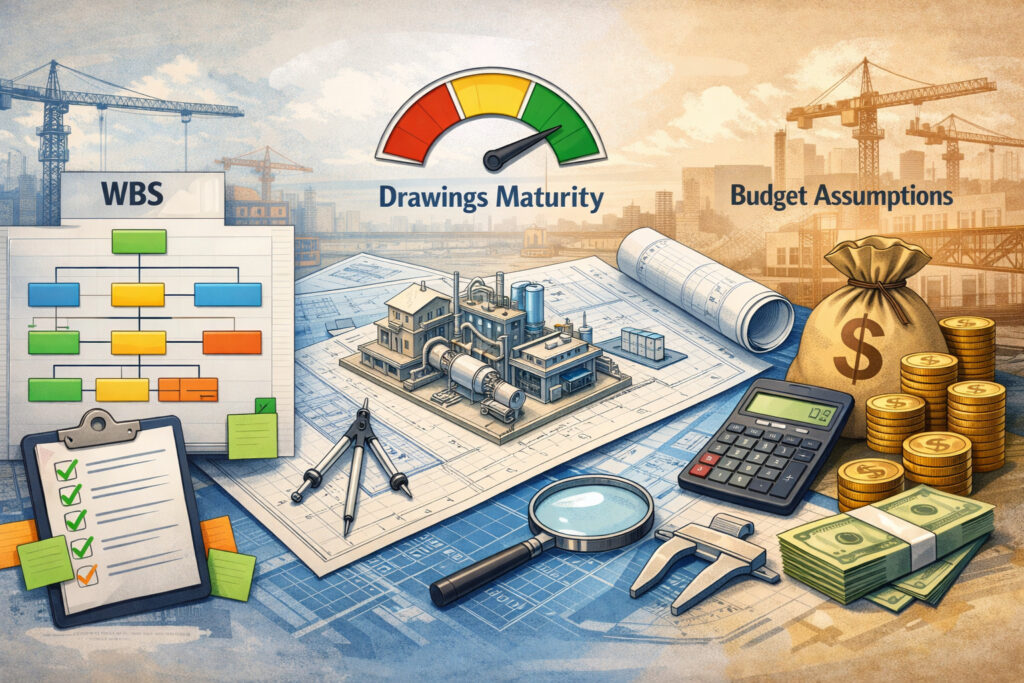
The fastest way to blow a construction budget is to estimate from a blurry scope. A reliable construction budget starts with a Work Breakdown Structure (WBS) that mirrors how work is bought and built.
Even for small projects, you want the scope broken into logical buckets like sitework, foundations, structure, envelope, interiors, MEP, and general conditions. For commercial work, match your WBS to standard cost codes so your estimate becomes your tracking system later.
Next, rate your drawings. Are you at concept, schematic, design development, or construction documents? Budget accuracy depends on this. A concept budget can be off by a wide margin.
That’s not a failure—it’s normal. But you must label it correctly and include appropriate contingency. The more your team pretends early drawings are “final,” the more painful the corrections become.
Assumptions are not “fine print.” They’re the core of a construction budget. Document allowances, unit counts, ceiling heights, wall types, equipment quantities, and any design features that drive cost (glass area, structural spans, HVAC zoning, fire protection class).
Add site assumptions like soil conditions, dewatering needs, demolition extent, and access constraints. Site unknowns, in particular, are where budgets go to die.
Finally, connect scope to performance. If the project needs enhanced energy performance, resilience upgrades, or specialized systems (data, security, lab-grade ventilation), those must be explicit in the construction budget from the start.
Use a “Scope Freeze Ladder” to Reduce Late Changes Without Stalling Progress
People fear scope freezes because they worry it will slow the project. A better approach is a scope freeze ladder—locking decisions in phases based on what affects procurement and schedule.
Start by freezing items with long lead times (switchgear, rooftop units, curtainwall, elevators) because late changes can add months and explode general conditions.
Next, freeze structural and envelope decisions. Those drive engineering, permitting, and many downstream costs. Then freeze MEP routing and major equipment. Finally, freeze finishes and aesthetics after the “bones” are set. This sequence keeps design moving while protecting the construction budget from late-stage chaos.
Pair each freeze step with a cost check. When a scope element is locked, update the construction budget line items and reduce contingency if uncertainty truly decreases. This makes contingency a real risk tool, not a slush fund.
If someone wants to reopen a frozen decision, require a written impact statement and approval. That isn’t bureaucracy—it’s how you keep a construction budget working.
Gather Cost Intelligence: Unit Costs, Assemblies, and Market Reality

A construction budget is only as good as its inputs. Instead of relying on one “cost per square foot,” build cost intelligence from three sources: (1) recent local projects, (2) current subcontractor feedback, and (3) published cost indexes for trend direction. Published indexes help you understand movement over time, especially for escalation planning.
Use assemblies early. For example, estimate the building envelope as an assembly (framing + insulation + sheathing + cladding + labor + equipment) rather than guessing each component separately. Assemblies are faster and more accurate when drawings are early.
Validate big drivers with real quotes. Even early in design, you can get budget pricing on steel, concrete, mechanical equipment, glazing, and roofing. If a subcontractor won’t quote, ask for a budget range and lead time assumptions.
Lead times matter because they influence schedule—and schedule affects general conditions and financing, which must appear in the construction budget.
Be realistic about labor. Many markets continue to face structural labor constraints, which can increase wage pressure and reduce trade availability.
When trade partners are scarce, contractors add risk premium or extend schedules—both hit the construction budget. Recent industry outlooks emphasize labor shortages as an ongoing constraint into 2026.
Apply Escalation and Timing: Don’t Budget Like You’re Buying Everything Today
A common budgeting mistake is pricing the whole project at today’s rates even when procurement happens months later. A better construction budget separates “cost at today’s pricing” from “cost at expected buyout dates.”
Create a simple escalation model. Assign each major trade a procurement month, then apply an escalation rate that reflects your market conditions and current index signals. Even a conservative escalation line is better than ignoring timing. Some cost data sources publish ongoing index movement and inflation measures that can guide this planning.
Also budget for long-lead risk. If your project depends on electrical gear or specialized HVAC, add an allowance for expedite fees, temporary power solutions, or alternate-equipment engineering. Those costs show up frequently now, especially on projects with complex electrical loads.
Finally, update this model at every design milestone. The construction budget should tighten over time. If it doesn’t, that’s a sign scope is still fluid—or your inputs aren’t grounded.
Structure the Construction Budget: Hard Costs, Soft Costs, and Owner Costs
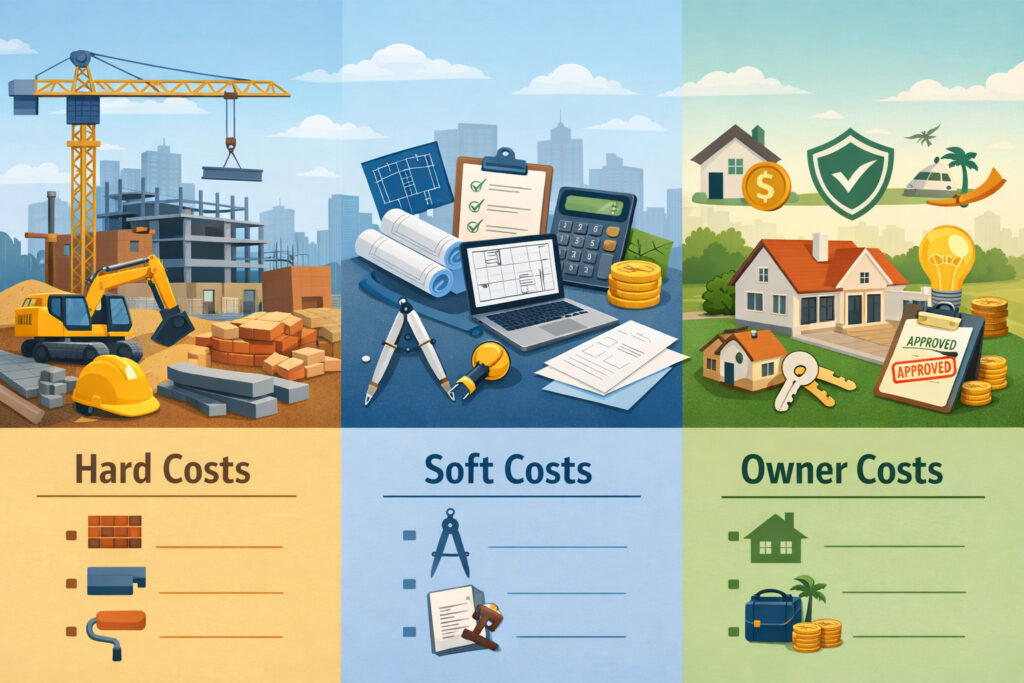
A construction budget that ranks in real life separates costs clearly. Hard costs are the physical work: labor, materials, equipment, and subcontractor scopes.
Soft costs are professional services and project support: design fees, engineering, permits, testing, legal, and sometimes project management. Owner costs include land, financing, furnishings, specialty equipment, and move-in expenses. When these are mixed together, people argue about what “over budget” even means.
For hard costs, include general conditions explicitly: site supervision, temporary facilities, safety, dumpsters, equipment rentals, temporary utilities, and schedule-related overhead. General conditions can rise sharply if the schedule extends, so treat schedule risk as budget risk.
For soft costs, don’t forget surveys, geotechnical reports, commissioning, third-party inspections, environmental reviews, and utility coordination. These are often required to permit and insure the project. For owner costs, include contingency for owner-selected items that tend to evolve (AV systems, IT closets, access control, signage, furniture, appliances).
Taxes and fees vary by jurisdiction. Build them into the right bucket so you don’t misread construction budget performance. A budget that “works” is transparent enough that you can explain every variance without hand-waving.
Include Financing and Cash Costs: Interest, Draw Fees, and Retainage Affect Real Budget
Many budgets ignore the cost of money. But financing can materially change project affordability. If you’re using a loan, you may have interest carry, lender inspection fees, draw fees, legal fees, and reserves. These are not “optional.” They’re part of the all-in construction budget outcome.
Cash flow also drives behavior. If you pay suppliers slowly, you may get pricing penalties. If you need to accelerate the schedule, you may pay overtime or premium labor rates. If retainage is held, subcontractors may price that risk into bids. These realities belong in the construction budget assumptions.
A practical approach is to add a “cash and financing” section that estimates monthly interest carry based on the draw curve. Even a rough model helps you choose between schedule options and procurement strategies. It also prevents the painful surprise where the project “fits” the construction budget on paper but not in cash.
Plan Contingency Like a Pro: Design, Construction, and Escalation Reserves
Contingency is not a guess. It’s a structured reserve that matches uncertainty. A working construction budget typically includes at least three reserve types:
- Design contingency: covers missing details or evolving scope when drawings are early.
- Construction contingency: covers field unknowns and coordination issues.
- Escalation contingency: covers price movement between estimate and buyout.
The most common error is using one lump contingency for everything. That hides the cause of risk and makes it easier to spend contingency on upgrades. Instead, keep categories separate and release them only when the risk is retired.
For example, design contingency can shrink as design reaches construction documents, while escalation contingency might remain until major trades are contracted.
Index data and industry outlooks suggest costs can still be pressured by labor constraints and policy uncertainty, so treating escalation as a real line item (not a hope) is increasingly common practice.
Use Allowances and Alternates Without Destroying Budget Discipline
Allowances and alternates are tools—but only if they are controlled. An allowance is a placeholder for a defined scope not fully selected yet (like tile at $X per square foot). An alternative is a bid option (add or deduct) that helps you choose scope after pricing is known.
To keep a construction budget working, every allowance must have: (1) a clear scope description, (2) a unit basis, (3) what’s included (labor, tax, waste), and (4) what happens if actual cost differs. Every alternate should be tied to a decision deadline so it doesn’t float forever.
Also avoid “allowance stacking.” If you have allowances inside subcontractor bids plus a top-level allowance in the construction budget, you may be double-counting—or worse, nobody owns the risk. Make it clear who holds each allowance and how it converts to actual costs.
Finally, document what is not covered by allowances. If the allowance is only for materials, but labor is billed as actual, say it upfront. Clarity is what makes a construction budget work under pressure.
Choose a Delivery and Procurement Strategy That Fits the Budget Goal
How you buy the work affects the construction budget. Lump sum bidding can provide a firm price, but it often comes with a higher risk premium if drawings are incomplete.
GMP (Guaranteed Maximum Price) can start earlier and manage uncertainty, but it requires strong cost transparency and disciplined change control. Design-build can compress schedules, but it demands careful scope definition so performance expectations don’t drift.
Procurement timing matters just as much as contract type. If you wait too long, you may face fewer bidders and higher prices. If you buy too early with incomplete design, you may pay for redesign and rework.
A working construction budget includes a procurement plan: when each trade is bid, when it’s contracted, and what assumptions are locked at that moment.
For long-lead trades, consider early procurement packages. For example, buy structural steel or major mechanical equipment early with defined performance specs. This can reduce escalation risk and protect schedule, but it must be coordinated with design.
Industry commentary going into 2026 continues to emphasize cost control, labor constraints, and tariff or policy uncertainty—factors that make procurement strategy a core part of construction budgeting, not an afterthought.
Run Bid Leveling Correctly: The “Cheap” Bid Often Becomes the Most Expensive
Bid leveling is where many construction budgets quietly fail. If you compare bids only by total price, you can miss exclusions, scope gaps, and unrealistic assumptions that turn into change orders. A working construction budget requires a detailed bid leveling sheet aligned to your cost codes and scope narratives.
Normalize bids by adding missing scope and subtracting duplicates. Confirm unit quantities, clarifications, and alternates. Verify schedule commitments and manpower assumptions—because a low bid that can’t staff the job can create delays that increase general conditions and financing costs.
Also check contract terms. Payment schedules, material escalation clauses, and insurance requirements can change real cost. If a subcontractor refuses standard terms, the risk might be worth more than the savings.
Finally, treat bid leveling as a budget update event. When bids come in, update the construction budget baseline and re-check contingency. The goal is not to “force” the project to match the old number. The goal is to produce a construction budget that reflects reality and supports smart decisions.
Create Cash Flow and Cost Controls: From Budget to Commitments to Forecast
A construction budget works when it connects to how money is committed and spent. Start with cost codes. Even on a smaller project, basic cost coding helps you track commitments (signed contracts and purchase orders), actual costs (invoices and pay apps), and forecasted final cost.
The key metric is Estimate at Completion (EAC)—what you believe the project will cost when finished. EAC is not the same as “budget remaining.” A working construction budget updates EAC every month based on progress, change trends, and risk.
Pair this with a cash flow curve. Your lender or internal finance team needs a realistic draw schedule. Cash flow depends on procurement timing, front-loaded materials, retainage, and seasonal productivity. If your cash plan is wrong, you can face funding gaps even if the final construction budget total is unchanged.
Cost controls also require discipline around approvals. Every commitment must map to the correct budget line. Every change must be logged immediately. The construction budget should never be updated “later,” because later is how surprises grow.
Use Earned Value Light: Simple Progress-Based Forecasting Without Corporate Complexity
You don’t need a giant program to forecast well. A simplified earned value approach can dramatically improve construction budget accuracy. For each major cost code, track: (1) budget, (2) committed, (3) paid-to-date, and (4) percent complete.
If a trade is 30% complete but has billed 60% of its value, you have a warning sign. Maybe materials were front-loaded, or maybe productivity is lagging. If a trade is 70% complete but has only billed 40%, you may be underbilling—or missing costs that will hit later. These patterns help you predict the final construction budget outcome early.
Combine this with a “risk register” tied to dollars. List top risks (soil unknowns, design gaps, utility delays, long-lead procurement) and assign a realistic dollar range. Update it monthly. When a risk is resolved, release that reserve. When a new risk appears, capture it immediately.
This approach keeps the construction budget honest. It turns budgeting into management, not guesswork.
Control Changes: The System That Protects the Construction Budget in the Real World
Change is normal in construction. What’s not normal is unmanaged change. A working construction budget has a change control system that starts in preconstruction and continues through closeout.
First, define what counts as a change. Owner-requested scope changes, design clarifications that add work, unforeseen conditions, and code-driven revisions should all be tracked. Second, define categories: additive, deductive, contingency-funded, or allowance-reconciled. Third, define the timeline: when a change must be priced, approved, and implemented.
Track two totals: approved changes and potential changes. Approved changes are signed and funded. Potential changes are pending and should be included in forecasting. Many construction budgets fail because teams ignore potential changes until they become approved—and by then it’s too late to react.
Also audit change causes. If you see repeated design omissions, invest in coordination and clash detection. If you see repeated owner-driven upgrades, tighten decision gates. Change data is feedback that improves the construction budget process over time.
Close the Loop: Lessons Learned That Make the Next Construction Budget Stronger
A construction budget is a learning system. At the end of the project, compare estimated vs. actual at the line-item level. Identify what drove variances: quantity errors, productivity, scope gaps, escalation, weather, permitting delays, or late decisions.
Capture unit costs and production rates. Store real bid tabs and clarifications. Document which allowances were accurate and which were not. This creates a historical database that makes future construction budget work faster and more accurately.
Also evaluate schedule impacts. If the project extended, quantify how much that extension cost in general conditions, equipment rentals, and financing. That data helps you budget more realistically next time.
Teams that do this consistently build budgets that are not only accurate—but resilient. That’s what “works” means: the construction budget becomes a predictable tool, not a recurring crisis.
Use Modern Tools: Software, 5D BIM, and Data-Driven Forecasting
Technology won’t fix a broken process, but it can dramatically strengthen a good one. Estimating software and cloud cost databases improve consistency and speed. 5D BIM connects quantities and model-based scope to costs, helping teams spot missing elements and coordinate design decisions before they become field changes.
Digital workflows also improve accountability. When RFIs, submittals, and changes are tracked in one system, your construction budget updates become faster and more accurate. Some industry tech landscape reporting suggests AI-driven tools can help reduce errors and improve productivity by surfacing patterns in schedule and cost data.
The best use case for modern tools is forecasting. If your system can show committed costs, pending changes, burn rate, and productivity indicators, your construction budget becomes predictive—not reactive.
That said, keep tools simple enough that the team uses them. A lightweight, well-maintained system beats a complex one that nobody updates. The goal is better decisions, not more dashboards.
Future-Proof the Construction Budget: Prefab, Resilience, and the Next Wave of Cost Drivers
Looking forward through 2026–2030, several trends are likely to shape construction budget strategy. Labor constraints are expected to remain a structural issue in many markets, pushing teams to consider prefab, modularization, and automation for repeatable scopes.
Material volatility may also persist due to supply chain shifts, tariffs, and demand spikes in sectors like data centers and infrastructure. That doesn’t mean you can predict exact prices—but it does mean a construction budget should include explicit escalation planning, alternates, and procurement flexibility.
Resilience is another cost driver that will increasingly be treated as non-optional. Weather hardening, drainage, envelope upgrades, backup power, and water management can add upfront cost but reduce lifecycle risk.
Budgeting will continue to expand beyond “build cost” into “total cost of ownership,” especially for owners focused on operating expenses and downtime risk.
A future-ready construction budget is built to absorb uncertainty. That means better scope definition, smarter procurement, and tighter forecasting—not just a bigger contingency.
FAQs
Q.1: What’s the difference between an estimate and a construction budget?
Answer: An estimate is a calculation of expected costs based on scope and assumptions. A construction budget is the management plan that uses that estimate as a baseline, then adds governance: contingency rules, cash flow planning, procurement timing, and change control.
In other words, the estimate is the “price picture,” while the construction budget is the “financial operating system.”
A construction budget includes categories many estimates exclude, like owner costs, financing, permitting, testing, commissioning, and reserves. It also includes timelines: when costs will be committed and when cash will be paid out.
That’s why a project can “match the estimate” but still face funding problems—because the construction budget wasn’t designed to manage cash flow and timing.
If you want the construction budget to work, keep the estimate as a snapshot and treat the construction budget as a living model. Update it at milestones, convert assumptions into commitments, and forecast the final cost every month.
Q.2: How much contingency should a construction budget include?
Answer: The right contingency depends on design maturity and risk profile. Early concept budgets carry higher uncertainty, so contingency is typically higher. As design develops and bids are received, contingency should become more precise and sometimes reduce—if risk truly decreases.
A practical construction budget separates contingency types: design contingency, construction contingency, and escalation contingency. This prevents people from spending reserve money on upgrades while pretending it’s “risk coverage.”
It also makes approvals clearer: if a design omission caused the cost, it shouldn’t come out of the same bucket as an unforeseen field condition unless your rules say so.
The biggest mistake is picking a single percentage because “that’s what we always do.” A working construction budget uses a risk register with dollar ranges tied to specific risks and retires contingency as those risks are resolved.
Q.3: How do I budget for material price increases without guessing?
Answer: You don’t need perfect prediction. You need a process that acknowledges timing. Start by assigning buyout dates to major trades and long-lead items. Then apply a conservative escalation factor to those future months.
Use published cost index movement for direction, and validate with subcontractor feedback on current market conditions and lead times.
Next, reduce escalation risk through strategy: early procurement packages, approved alternates, and spec flexibility (for example, allowing equivalent products). Build allowances for long-lead volatility where appropriate, and avoid over-customizing systems that have limited supplier options.
Finally, update escalation assumptions at every milestone. A construction budget that works doesn’t lock escalation once and hope. It recalibrates as procurement becomes real.
Q.4: What are the most commonly missed line items in a construction budget?
Answer: The most missed items are usually not the obvious building components. They’re “support” and “transitions.”
Common misses include: utility connection fees, temporary power and water, testing and inspections, commissioning, permit revisions, erosion control, traffic control, dumpsters, cleaning, builder’s risk insurance, bonds, owner-furnished equipment installation, IT/AV coordination, access control, signage, and closeout documentation.
General conditions are also frequently underestimated, especially when the schedule expands. If you add weeks, you add supervision, rentals, temporary facilities, and overhead—sometimes dramatically.
A good construction budget uses a checklist by phase: preconstruction, mobilization, rough-in, finishes, commissioning, and closeout. Misses happen when people only think about “building parts” and forget the work required to legally complete, occupy, and operate the space.
Q.5: How can I keep the construction budget on track once construction starts?
Answer: You keep a construction budget on track by controlling three flows: commitments, changes, and forecasts. First, track commitments—signed subcontracts and purchase orders—against budget line items.
Second, track changes immediately, including pending (unapproved) changes. Third, forecast the final cost monthly using Estimate at Completion, not just “budget remaining.”
Use percent-complete checks to spot billing anomalies and productivity issues. If costs are burning faster than progress, investigate early. Also hold regular budget reviews tied to the schedule: upcoming procurement decisions and long-lead deliveries should trigger budget checks.
Most importantly, keep a clear approval process. If teams can add scope informally, the construction budget becomes meaningless. A working construction budget is protected by governance, not optimism.
Q.6: Is construction budgeting likely to change in the next few years?
Answer: Yes. The construction budget process is shifting toward more dynamic forecasting, earlier procurement planning, and technology-supported quantity and risk management. Labor constraints are pushing more prefab and modular strategies, which change how you budget (more cost moves upstream into fabrication and logistics).
Cost volatility and policy uncertainty are also driving more explicit escalation planning and alternate-ready specifications. Projects that depend heavily on complex electrical infrastructure—like data-heavy facilities—are influencing market pricing and availability in some regions, which can spill over into other projects.
Meanwhile, 5D BIM and data-driven tools are becoming more common for coordinating scope and reducing surprises. The future construction budget will look less like a static document and more like a continuously updated financial model that ties directly to scope decisions and procurement reality.
Conclusion
If you want a construction budget that works, build it like you build the project: with structure, sequence, and controls. Start with a clear scope backbone and documented assumptions. Use real market inputs, assemblies, and timing-based escalation.
Separate hard costs, soft costs, owner costs, and financing so stakeholders stop talking past each other. Plan contingency as a risk tool with categories and release rules. Choose procurement strategies that fit your schedule and uncertainty.
Then protect the construction budget during construction with cost codes, commitments tracking, disciplined change control, and monthly forecasting.
The projects that stay financially healthy aren’t the ones with “perfect” estimates. They’re the ones with a construction budget system that detects problems early and makes decisions easy.
When your construction budget is built to evolve—tightening as scope firms up and forecasting as realities change—you don’t just reduce overruns. You gain confidence, speed, and control from concept to closeout.