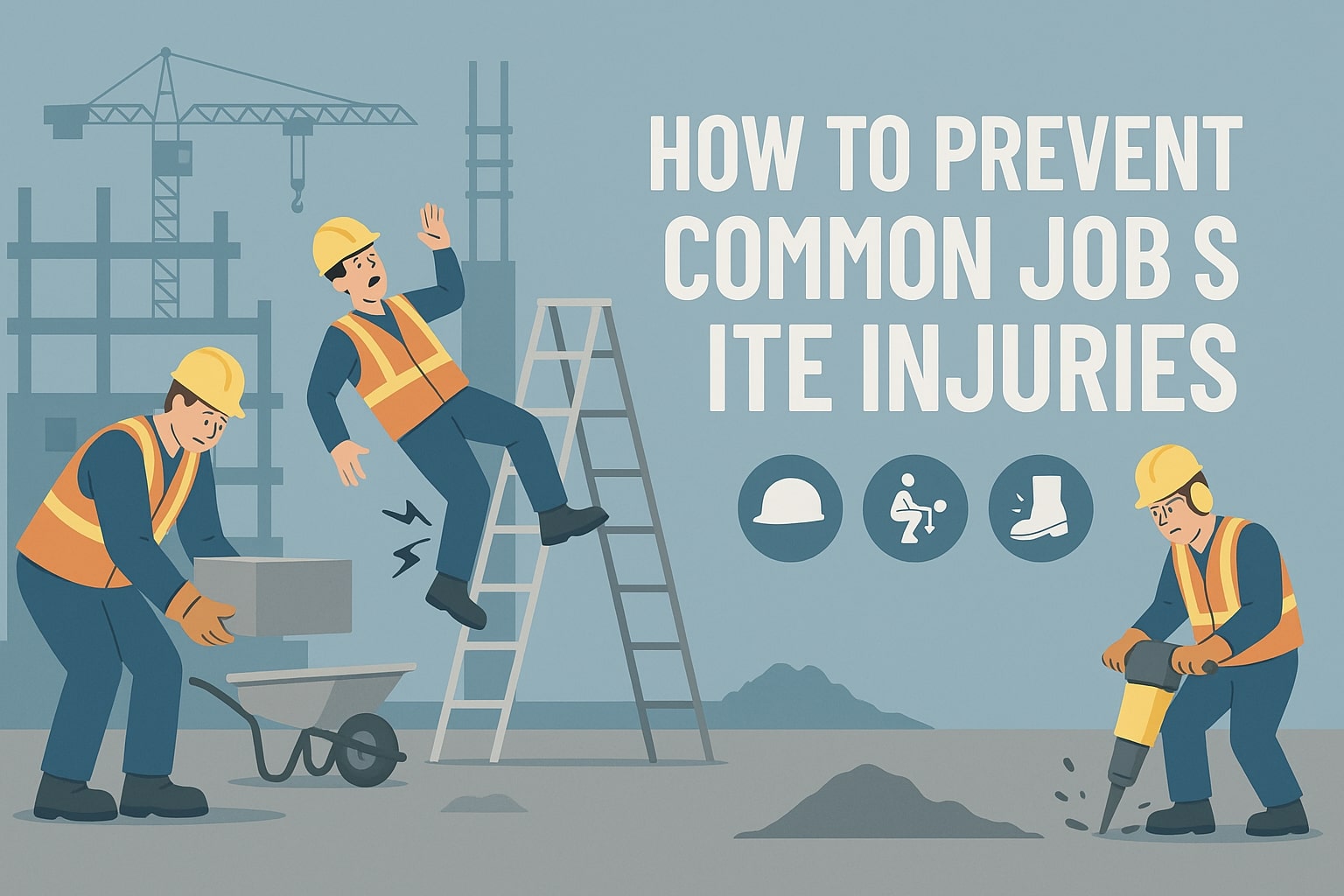
How to Prevent Common Job Site Injuries
Preventing common job site injuries isn’t just a regulatory box to check—it’s the difference between workers going home safe and a life-changing incident. In the U.S., construction and other high-risk job sites consistently rank among the most dangerous workplaces, with thousands of serious injuries and hundreds of fatalities every year.
Falls, struck-by incidents, electrocutions, and caught-in/between accidents—the “Fatal Four”—still account for the majority of deaths on construction job sites.
When you understand how to prevent common job site injuries, you lower workers’ compensation costs, avoid OSHA penalties, and build a culture where people want to work.
This guide walks through up-to-date OSHA guidance, proven safety strategies, and emerging tech tools—so you can protect your crews today and position your company for a safer future. We’ll cover how injuries happen, what controls actually work, how to stay compliant, and how to use data and technology to stay ahead of risk in the next five to ten years.
Whether you’re a general contractor, subcontractor, safety manager, or site supervisor, these practical steps can help you dramatically reduce common job site injuries and create safer, more efficient, and more profitable projects across the U.S.
Why Preventing Common Job Site Injuries Should Be Your Top Priority
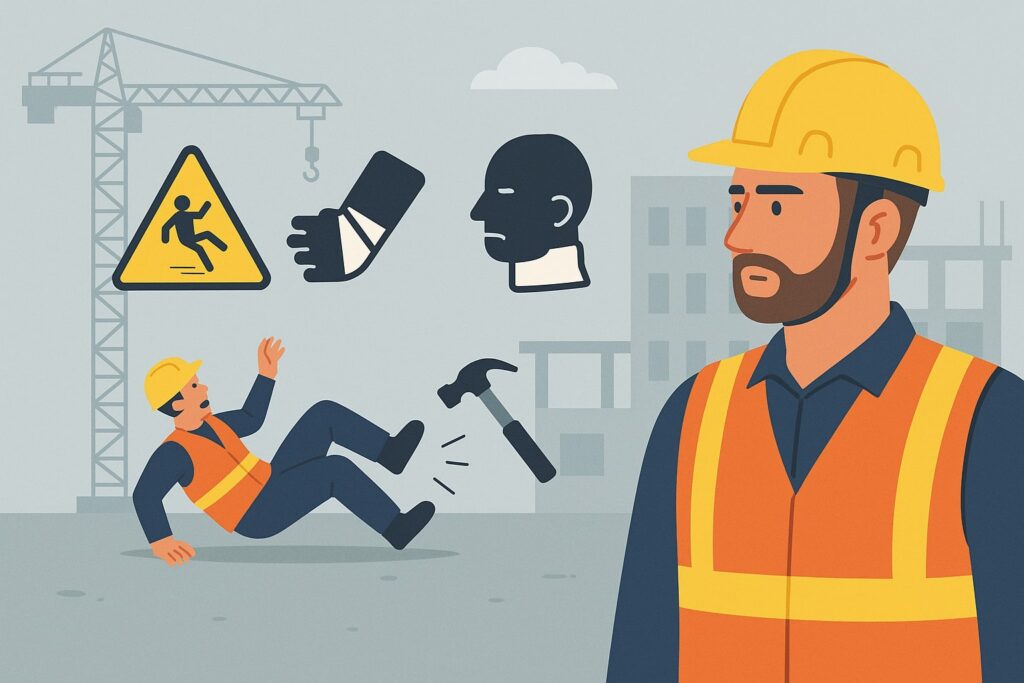
Preventing common job site injuries matters for three big reasons: people, profitability, and compliance. First and most important, every worker has a right to a safe workplace under the Occupational Safety and Health Act.
When falls, struck-by incidents, or electrocutions happen, the impact on families and coworkers can last a lifetime. In 2021 alone, there were 5,190 fatal work injuries in the U.S., and nearly 20% of them were in construction.
From a business perspective, common job site injuries are extremely expensive. Direct medical claims are only part of the picture.
You also pay for lost productivity, overtime to cover injured workers, project delays, retraining, higher insurance premiums, and potential legal costs. Many safety pros use the rule of thumb that indirect costs can be three to five times the direct claim.
Compliance is the third pillar. OSHA’s most frequently cited standards repeatedly highlight fall protection, ladders, scaffolds, hazard communication, and machine guarding as major problem areas.
Failing to control known hazards can result in five-figure or even six-figure penalties, reputational damage, and—after a serious incident—possible criminal exposure.
Looking ahead, owners, GCs, and government agencies are increasingly demanding strong safety records as a precondition for winning bids.
Over the next decade, expect safety metrics and leading indicators (like near-miss reporting and training completion) to become standard prequalification filters. Investing now in preventing common job site injuries positions your company as a low-risk, high-reliability partner.
The Most Common Job Site Injuries in the U.S.
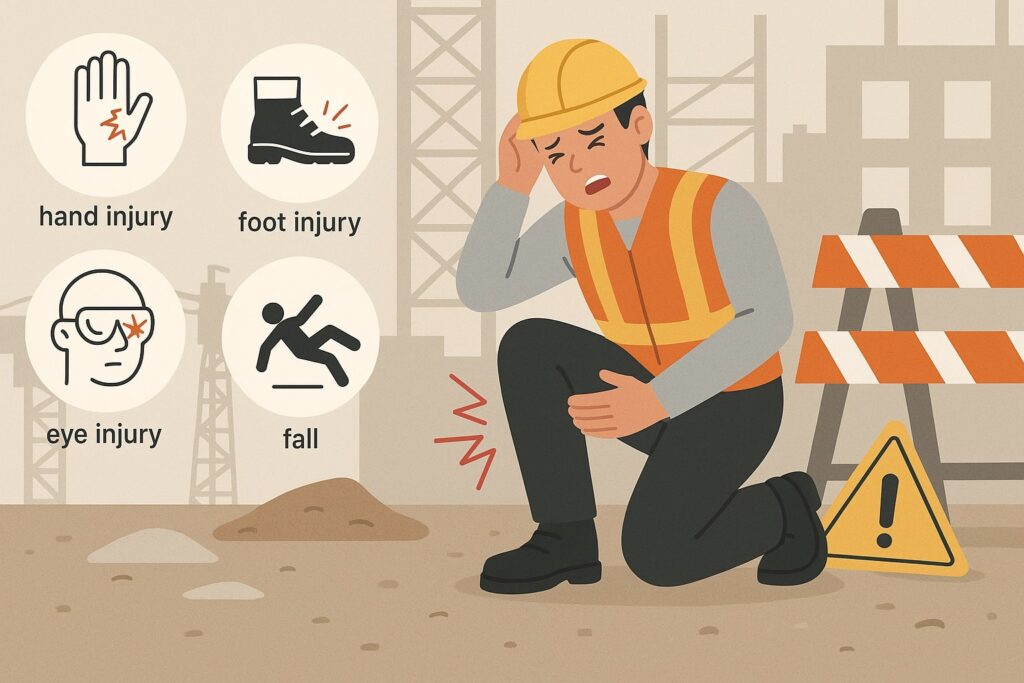
Common job site injuries tend to follow predictable patterns. OSHA and NIOSH data show that a relatively small group of hazards causes the majority of serious injuries and deaths: falls, struck-by incidents, electrocutions, and caught-in/between accidents. Together, these “Fatal Four” account for more than half of construction-related fatalities each year.
Beyond the Fatal Four, many job sites also struggle with overexertion, repetitive strain, cuts and lacerations, and vehicle-related incidents in work zones.
While these events may not always be fatal, they still contribute significantly to lost-time cases and workers’ compensation costs. Understanding how these common job site injuries happen is the first step toward prevention.
In the U.S. today, falls remain the number one cause of death in construction and the top OSHA citation year after year. Struck-by incidents often involve heavy equipment, swung loads, or falling tools and materials.
Electrocutions frequently result from contact with overhead power lines or energized parts. Caught-in/between cases can involve trench cave-ins, rotating equipment, or being pinned between a vehicle and a fixed object.
Over the next few years, industry experts expect these same categories of job site injuries to remain dominant, but with a growing emphasis on musculoskeletal disorders and mental fatigue as work intensifies and schedules compress. That means prevention strategies must address both physical and human-factor risks.
Falls From Heights and Same-Level Falls
Falls are the single most deadly and costly category of common job site injuries in U.S. construction. OSHA’s fall-protection standard (29 CFR 1926.501) has topped the agency’s “Top 10 Most Frequently Cited Standards” list for more than a decade.
Falls occur from roofs, scaffolds, ladders, unprotected edges, floor openings, and even from short step-stools or trailers. Same-level slips and trips can also cause serious sprains, fractures, and head injuries.
Preventing falls starts with engineering controls: guardrails, properly built and inspected scaffolds, secured ladders, and covers on floor openings that are clearly labeled and able to withstand expected loads.
Housekeeping matters, too. Keeping walkways clear, cleaning up spills quickly, and managing cords and hoses significantly reduces slip and trip injuries.
Whenever workers are six feet or more above a lower level on a construction site, OSHA requires some form of fall protection—such as guardrails, safety nets, or personal fall arrest systems (PFAS).
Training workers to inspect harnesses, lanyards, and anchorage points, and ensuring they actually tie off 100% of the time, are critical parts of preventing these job site injuries.
In the future, expect more use of self-retracting lifelines, engineered anchor points prebuilt into structures, and wearables that detect sudden motion or proximity to edges.
Drone inspections and Building Information Modeling (BIM) can help plan work so tasks at height are minimized or moved to controlled environments, further reducing fall exposure.
Struck-By Incidents and Falling Objects
Struck-by incidents are another leading cause of common job site injuries. OSHA defines struck-by hazards as events where a worker is hit by a vehicle, flying object, falling object, or swinging load.
These injuries can involve cranes, forklifts, dump trucks, hand tools, nail guns, or suspended materials, and they often happen in busy, congested job sites where multiple trades are working at once.
Falling objects—like tools dropped from scaffolds or materials pushed off edges—can cause skull fractures, facial injuries, and traumatic brain injuries. That’s why OSHA and NIOSH emphasize securing tools, using toeboards and debris nets, and ensuring overhead protection in high-traffic areas.
High-visibility clothing also plays a major role in preventing struck-by injuries involving vehicles and heavy equipment. Workers must be easy to see in all light conditions, especially in roadway work zones.
To prevent common job site injuries caused by struck-by hazards, establish and enforce exclusion zones around cranes, lifts, and swing radii. Use spotters whenever equipment is backing or maneuvering in tight areas.
Require radios or hand signals to coordinate movements. Make sure loads are rigged by qualified workers, and never allow anyone to walk or work under a suspended load.
Looking ahead, collision-avoidance systems, proximity alarms, and AI-enabled cameras will increasingly monitor blind spots and alert operators and pedestrians before a struck-by incident occurs.
Over the next decade, expect more integration between equipment telematics and site safety data, allowing safety teams to identify high-risk behaviors and intervene early.
Caught-In/Between Accidents and Trench Collapses
Caught-in/between accidents occur when a worker is crushed, pinned, squeezed, or trapped between objects. On many job sites, the most severe examples involve trench collapses, unguarded moving machinery, and workers caught between vehicles and fixed structures.
OSHA includes caught-in/between events among the Fatal Four due to their high fatality rate and the speed at which they can occur.
Trenching and excavation work is particularly dangerous. A single cubic yard of soil can weigh as much as a small car, and cave-ins can happen with no warning.
To prevent common job site injuries in trenches, OSHA requires protective systems—sloping, shoring, or shielding—for trenches five feet or deeper, unless rock-solid stable ground is proven. A competent person must inspect trenches daily and after any rain or changes in conditions.
Equipment-related caught-in/between injuries often occur when guards are removed from rotating shafts, belts, or gears, or when workers place their hands or body inside moving machinery. Following lockout/tagout procedures, guarding all points of operation, and maintaining safe distances from rotating and crushing hazards are essential.
In the future, expect smarter trench monitoring with sensors that detect ground movement or water accumulation and warn crews before conditions become unstable.
For machinery, more manufacturers are integrating interlocks that automatically stop motion when guards are removed. Vision systems and light curtains will continue to expand, shutting down equipment when workers enter a danger zone, thereby reducing these job site injuries.
Electrocutions and Contact With Power Lines
Electrocutions are another major category of common job site injuries and one of OSHA’s Fatal Four. These incidents often involve contact with overhead power lines, energized panels, temporary wiring, or damaged extension cords. Even relatively low voltage can cause fatal shock, burns, or falls from ladders and scaffolds when workers are startled.
Preventing electrocutions starts with planning. Before work begins, identify all overhead and underground utilities and maintain required clearance distances from power lines—typically at least 10 feet, and more for higher voltages.
Coordinate with the utility company to de-energize or relocate lines when feasible. Use non-conductive ladders and tools near electrical sources and never use metal ladders close to power lines.
On the job site, follow lockout/tagout procedures to ensure circuits are de-energized and verified before anyone works on them. Use ground-fault circuit interrupters (GFCIs) on temporary power and extension cords, and remove damaged cords from service immediately.
Train workers to recognize the signs of unsafe wiring, overloaded circuits, or missing covers on panels and junction boxes.
To prevent common job site injuries from electricity in the future, more companies are adopting smart breakers, real-time monitoring of electrical loads, and wireless testers.
Expect increased use of augmented reality (AR) to help electricians and supervisors “see” hidden utilities and verify clearances. As electrification of equipment and EV charging infrastructure grows on projects, electrical safety training and advanced planning will become even more critical.
Overexertion, Repetitive Motion, and Musculoskeletal Injuries
Not all common job site injuries are dramatic events like falls or electrocutions. Overexertion, repetitive motion, and awkward postures cause many musculoskeletal disorders (MSDs), including back injuries, shoulder strains, tendinitis, and knee problems.
These injuries can sideline experienced workers for weeks or months and lead to chronic pain and disability.
MSDs often develop slowly as workers repeatedly lift heavy materials, push or pull loads, twist while carrying, or work overhead for long periods. Poor ergonomics—like working on knees without padding or using tools that require excessive force—exacerbate the risk.
Because these job site injuries may not show up as catastrophic events, they’re sometimes overlooked in safety programs.
Prevention strategies focus on redesigning tasks to reduce force, frequency, and awkward postures. Use mechanical lifts, hoists, dollies, and material handling equipment whenever possible.
Break down loads into smaller, manageable units. Rotate workers among tasks to avoid repetitive stress. Provide ergonomic tools with padded grips and low vibration, and train workers in proper lifting techniques and neutral body postures.
In the coming years, expect increased focus on ergonomics and human performance in construction. Wearable devices that monitor posture, exertion, and fatigue are already being piloted, giving real-time feedback to workers about risky movements.
Exoskeletons—both powered and passive—are emerging to support shoulders and backs during overhead or heavy work. As these technologies become more affordable, they will play a growing role in preventing common job site injuries tied to overexertion.
Vehicle, Equipment, and Traffic-Related Injuries
Vehicle and equipment incidents are a persistent source of common job site injuries. These events can involve dump trucks, loaders, forklifts, skid steers, delivery vehicles, and even passenger cars traveling through highway work zones.
The most serious injuries often result when workers are struck, run over, or crushed between a vehicle and a fixed object.
Key risk factors include blind spots, poor traffic control, backing without spotters, and mixing pedestrians with equipment in tight spaces. In roadway work zones, distracted drivers and high speeds add additional danger.
National statistics show transportation incidents (including roadway and pedestrian-vehicular incidents) are a leading cause of work-related deaths across all industries, not just construction.
To prevent common job site injuries involving vehicles, start with a traffic management plan. Separate vehicle routes from pedestrian walkways whenever possible, and clearly mark crossing points with signs and cones.
Require high-visibility clothing for anyone near moving vehicles. Enforce seat belt use and strict rules against cell phone use while operating equipment.
Operators must be trained and authorized for the specific equipment they use, with refresher training after any incident or near miss. Daily inspections of brakes, lights, alarms, and tires should be mandatory. Use spotters with radios in congested areas, especially when backing or swinging.
In the near future, more job sites will use telematics, GPS geofencing, backup cameras, and proximity sensors to monitor equipment movement and trigger alerts. Some systems already apply automatic braking when people or obstacles are detected.
As these technologies mature, they will be central tools for preventing common job site injuries related to vehicles and heavy equipment.
Building a Strong Job Site Safety Culture
No matter how many rules or devices you have, you can’t truly prevent common job site injuries without a strong safety culture. Safety culture is the shared beliefs, attitudes, and behaviors that determine how seriously people take hazards and procedures when nobody is watching.
On job sites with a weak safety culture, workers may ignore PPE requirements, skip pre-use inspections, and feel pressured to take shortcuts to meet schedule milestones.
A strong safety culture starts with clear expectations. Safety must be communicated as a core value—not a priority that changes when deadlines get tight.
Supervisors and foremen must model the behavior they expect, including wearing PPE, reporting near misses, and stopping work when something isn’t safe. When leaders cut corners, workers assume safety rules are optional.
Psychological safety is also crucial. Workers should feel comfortable speaking up if they see a hazard or don’t understand a task. Anonymous reporting options, open-door policies, and visible follow-through on concerns help build trust.
Recognizing and rewarding safe behavior, not just production, sends a powerful message that preventing common job site injuries is everyone’s job.
Over the next decade, expect more companies to use safety culture surveys, leading indicators, and human-performance tools to track and improve safety culture over time. Coaching-style supervision, peer observation programs, and digital apps for real-time feedback will be increasingly used to keep safety front-and-center on U.S. job sites.
Leadership Commitment and Accountability
Leadership commitment is the engine that drives any effort to prevent common job site injuries. When owners, executives, and project managers visibly prioritize safety, the rest of the organization follows.
This commitment must go beyond slogans. It should be reflected in budget decisions, staffing, training, and how leaders respond when safety and schedule are in conflict.
Accountability is key. Safety responsibilities should be clearly defined for every role—from senior leaders to foremen and craft workers. Supervisors must be held responsible not only for production, but also for safety performance and for reinforcing safe behaviors daily.
That includes praising good catches, correcting unsafe acts immediately, and documenting both positive and negative observations.
Safety walk-throughs are a powerful tool. When leaders regularly visit job sites, ask open questions about hazards, and listen to worker feedback, they demonstrate that preventing common job site injuries is a real priority.
These visits should focus on learning, not blame. When serious issues are found, leaders should ensure corrective actions are implemented and verified.
Future trends point toward more data-driven accountability. Digital platforms already track inspections, observations, and training.
In the coming years, many organizations will use dashboards that combine lagging indicators (like recordable injuries) with leading indicators (like near-miss reports, toolbox talk participation, and hazard corrections) to evaluate leadership performance and drive continuous improvement in job site safety.
Worker Involvement, Safety Committees, and Near-Miss Reporting
Workers are closest to the hazards, so involving them directly is essential to prevent common job site injuries. Safety committees that include representatives from different trades, supervisors, and management provide a structured way to gather input and share decisions.
These committees can review incident trends, suggest improvements, and help tailor training and toolbox talks to real job site conditions.
Near-miss reporting is another powerful tool. A near miss is an event that could have caused injury or damage but didn’t—this time. Treating near misses as free lessons, rather than reasons to punish people, encourages workers to come forward.
A simple, easy-to-use reporting process—paper forms, text messages, or mobile apps—makes it more likely that these events are captured before they become real injuries.
To boost participation, explain how near-miss reports are used. Share anonymized examples in toolbox talks, describe corrective actions taken, and track reductions in risk. When workers see that their reports lead to changes—better guardrails, revised procedures, new tools—they’re more likely to help prevent common job site injuries by speaking up again.
In the future, digital platforms will make worker involvement even easier. Apps for hazard observations, photo uploads, and quick surveys are becoming common.
Over time, analyzing this data with AI will help identify patterns—such as recurring hazards on certain tasks or at certain times—so safety teams can intervene proactively and fine-tune job site controls.
Safety Orientation, Ongoing Training, and Toolbox Talks
A one-time safety orientation is not enough to prevent common job site injuries. Workers need initial training, ongoing refreshers, and task-specific instruction as conditions change.
A strong orientation covers company safety rules, key job site hazards, emergency procedures, PPE requirements, and workers’ rights under OSHA. It should be understandable to workers of all literacy levels and languages; using visual aids and interpreters can make a huge difference.
Ongoing training dives deeper into specific hazards like fall protection, lockout/tagout, scaffold use, trench safety, and equipment operation.
OSHA and NIOSH both promote toolbox talks—short, focused safety discussions held regularly on the job site—as a highly effective way to reinforce safe practices. These talks should address real tasks planned for the day, use real examples, and invite questions and discussion.
To prevent common job site injuries, make training interactive. Demonstrate proper use of harnesses, ladders, or grinders. Let workers practice tying off or inspecting equipment under supervision.
Use near-miss reports and recent incidents (from your own sites or industry alerts) as learning tools. Always document attendance and topics for compliance and continuous improvement.
Looking ahead, expect more use of microlearning (short, targeted modules delivered via smartphones), virtual reality simulations for high-risk tasks like crane signaling or confined space entry, and multilingual content libraries.
These tools will help make safety training more engaging and accessible, especially for younger workers entering U.S. job sites.
Practical Controls to Prevent Common Job Site Injuries
Understanding hazards is only half the battle; you must implement practical controls to prevent common job site injuries. Safety professionals often talk about the “hierarchy of controls”: elimination, substitution, engineering controls, administrative controls, and personal protective equipment. The higher up the hierarchy, the more reliable the solution.
On job sites, you can sometimes eliminate a hazard by changing the method—prefabricating components at ground level instead of working at height, or using mechanical fasteners instead of hot work.
When elimination isn’t possible, engineering controls like guardrails, machine guards, and ventilation systems provide physical barriers between workers and hazards.
Administrative controls and PPE still matter, especially in dynamic environments like construction. Clear procedures, schedules that avoid fatigue, and well-enforced rules help ensure workers actually use the safeguards provided.
PPE—helmets, safety glasses, gloves, hearing protection, high-viz vests, and fall protection—acts as the last line of defense.
To prevent common job site injuries effectively, your program should combine all these controls in layers. For example, a fall-hazard control plan might include designing anchor points into the structure (engineering), writing a fall-protection plan and rescue procedures (administrative), and issuing harnesses and lanyards to trained workers (PPE).
The most successful contractors integrate these controls into pre-task planning, daily huddles, and quality checks.
Engineering Controls: Designing Hazards Out of the Job Site
Engineering controls are among the most powerful tools to prevent common job site injuries because they physically separate workers from hazards. Once properly installed, they don’t rely as heavily on individual behavior or constant supervision.
Examples include guardrails on roofs and edges, stair railings, properly designed scaffolds, trench boxes, machine guards, and noise-reducing barriers.
During the design and planning phases, look for opportunities to build safety into the project. Use prefabrication and modular construction to move work from exposed heights to controlled environments.
Design permanent anchor points for fall protection so future maintenance can be done safely. Provide adequate access platforms and walkways around equipment instead of expecting workers to “make do” with ladders.
On the job site, ensure that scaffolds are erected, altered, and dismantled only under the supervision of a competent person, and in accordance with OSHA standards. Guard moving parts of machinery with fixed guards, interlocks, or presence-sensing devices. Use trench shields or hydraulic shoring to protect workers in excavations.
In the future, BIM and digital twins will help project teams visualize hazards and design engineering controls much earlier. 3D models can highlight fall hazards, material flow, and equipment paths, allowing safety and design teams to collaborate on solutions before construction starts.
Over time, this proactive approach will become a major factor in preventing common job site injuries on complex U.S. projects.
Administrative Controls: Policies, Procedures, and Scheduling
Administrative controls are the rules, procedures, and work practices that help prevent common job site injuries when hazards can’t be fully engineered out.
While they rely more on human behavior, they are essential in dynamic job sites where conditions change daily. Examples include safe-work procedures, permit systems, signage, training requirements, and job rotation.
Start with clear written procedures for high-risk tasks—such as working at heights, operating cranes, entering confined spaces, or performing hot work. These procedures should identify hazards, required controls, PPE, and step-by-step instructions.
Make them accessible in the field, not just in a binder in the office. Use pre-task planning or Job Hazard Analyses (JHAs) to tailor procedures to that day’s conditions.
Scheduling is a critical but often overlooked administrative control. Compressed schedules, excessive overtime, and unrealistic deadlines increase fatigue and encourage shortcuts, which in turn increase job site injuries.
Planning enough time and resources for tasks allows crews to follow safe procedures without constant time pressure.
Permit systems—like hot-work permits, confined-space permits, and lift plans—ensure that high-risk work is reviewed and authorized by competent personnel. Signage and color-coded markings help workers identify hazards, routes, and exclusion zones at a glance.
Going forward, digital permit systems, electronic JHAs, and mobile apps will make administrative controls more efficient and transparent.
Data from these systems can be analyzed to identify patterns, such as recurring hazards on certain tasks, supporting more targeted interventions to prevent common job site injuries.
Personal Protective Equipment (PPE) That Actually Gets Used
PPE is the last line of defense in the hierarchy of controls, but it’s still essential to prevent common job site injuries, especially when other controls can’t fully remove risk.
Common PPE on U.S. job sites includes hard hats, safety glasses, hearing protection, gloves, high-visibility vests, respirators, and fall-protection equipment like harnesses and lanyards.
One challenge is PPE compliance. Workers may resist wearing PPE if it’s uncomfortable, doesn’t fit well, or interferes with the task. To improve usage, involve workers in selecting PPE.
Offer multiple sizes and styles, and consider climate conditions—lightweight, breathable PPE in hot weather, for example. Train workers not just on how to wear PPE, but why each item matters for preventing specific job site injuries.
Inspection and maintenance are also crucial. Damaged hard hats, scratched safety glasses, or worn-out harnesses may give a false sense of security.
Establish routines for inspecting PPE daily, replacing it when damaged or expired, and storing it properly. Supervisors should model correct PPE use and address noncompliance promptly and fairly.
In the future, expect more “smart PPE” with built-in sensors for impact, temperature, gas detection, or worker location. Connected hard hats, safety vests, and harnesses will feed data into site safety systems, enabling real-time alerts and more accurate reconstruction of incidents.
This convergence of PPE and technology will play a growing role in preventing common job site injuries over the next decade.
OSHA Compliance, Documentation, and Inspections
OSHA compliance is both a legal requirement and a practical framework to prevent common job site injuries. OSHA standards outline minimum protections for fall hazards, scaffolds, ladders, electrical work, excavations, hazard communication, machine guarding, and more.
The agency’s Top 10 most frequently cited standards highlight where many employers fall short, especially in fall protection, hazard communication, and ladders.
Documentation is a critical part of compliance. Employers must maintain records of injuries and illnesses (OSHA 300 logs for most covered employers), training records, inspection reports, and written programs for certain hazards.
These documents help demonstrate your efforts to prevent common job site injuries and can be invaluable during inspections, audits, or claims.
Regular self-inspections—conducted by supervisors, safety professionals, or joint safety committees—help identify hazards before OSHA or an insurance auditor does.
Corrective actions should be tracked to completion, not just noted. Many companies now use digital tools to log inspections, photos, and follow-ups for better accountability.
Looking ahead, OSHA is increasingly interested in leading indicators and safety culture, not just lagging injury rates. Future enforcement may place even more emphasis on whether employers have robust, data-driven safety and health programs—another reason to integrate compliance efforts with your broader strategy to prevent common job site injuries.
Key OSHA Standards That Affect Job Site Injuries
Several OSHA standards directly target the hazards behind common job site injuries. For construction, key standards include:
- Fall Protection (29 CFR 1926.501) – Requires fall protection at six feet and above, plus protection around holes, edges, and leading surfaces.
- Scaffolds (1926.451) – Sets requirements for scaffold design, construction, access, and guardrails.
- Ladders (1926.1053) – Covers ladder selection, use, and inspection.
- Hazard Communication (1910.1200) – Ensures workers know about chemical hazards via labels, Safety Data Sheets (SDS), and training.
- Electrical (Subpart K, and 1910.147 for lockout/tagout in general industry) – Addresses safe work practices around energized equipment.
Understanding and applying these standards is essential to prevent common job site injuries such as falls, struck-by incidents, electrocutions, and chemical exposures. Many states with their own OSHA-approved plans adopt similar or stricter standards, so always check your local requirements.
Employers should ensure that competent persons are designated where required (for example, for scaffolds and excavations) and that they have the training and authority to correct hazards.
Regularly review OSHA’s Top 10 list and enforcement trends to see how inspectors are focusing their efforts and where your programs may need strengthening.
Over the next few years, expect continued emphasis on fall protection, as it remains the most frequently cited standard and the leading cause of construction deaths. New or updated standards may also address heat stress, silica, and other emerging health risks, further shaping how contractors prevent common job site injuries.
Preparing for OSHA Inspections and Using Data to Improve
OSHA inspections can be triggered by severe injuries, worker complaints, referrals, or programmed emphasis programs. Being prepared not only reduces stress, it also demonstrates your commitment to preventing common job site injuries.
Preparation starts with having required postings, records, and written programs organized and accessible. Supervisors should know how to respond if an inspector arrives—who to contact, where documents are stored, and how to accompany the inspector on the walk-around.
During inspections, OSHA will look at work practices, interview employees, and review documentation. If violations are found, citations and penalties may follow. But the real value is in using the findings to improve.
Conduct a root-cause analysis for any cited conditions or serious near misses. Ask why the hazard existed, why it was not identified earlier, and what system changes are needed.
Data is a powerful ally. Track not only injuries, but also near misses, hazard reports, training, and inspections. Analyze which tasks, locations, or times of day are associated with more issues. Use this insight to prioritize controls and training that prevent common job site injuries.
In the future, safety analytics platforms will automatically pull in data from multiple sources—incident reports, wearables, equipment telematics, and even weather feeds—to generate predictive risk scores.
Companies that embrace these tools will be better positioned to anticipate and prevent job site injuries before they occur.
Workers’ Compensation, Recordkeeping, and Return-to-Work Programs
Workers’ compensation and OSHA recordkeeping requirements shape how companies track and respond to common job site injuries. Most U.S. employers must carry workers’ compensation insurance, which pays for medical care and partial wage replacement for injured employees.
OSHA recordkeeping rules require many employers to log work-related injuries and illnesses, distinguishing between first-aid cases, recordables, restricted-duty cases, and lost-time incidents.
Accurate reporting is essential—not to “hide” injuries, but to understand where and why they are happening so you can prevent common job site injuries more effectively. Review logs and claims regularly to identify patterns by trade, task, project, or supervisor.
Involve your insurer or broker in analyzing trends and developing targeted interventions, such as ergonomic improvements or specialized training.
Return-to-work programs help injured employees transition back safely, often starting with modified duties. These programs reduce costs, maintain worker engagement, and lower the risk of long-term disability. They must be coordinated with healthcare providers to ensure restrictions are respected and job site injuries are not aggravated.
In the coming years, more U.S. insurers are likely to offer incentives and premium credits for companies that implement formal safety management systems, participate in collaborative risk-control programs, and use data analytics.
Organizations that can show clear, sustained reductions in common job site injuries will be better positioned to negotiate favorable rates and maintain a stable workforce.
Technology and the Future of Preventing Job Site Injuries
Technology is rapidly changing how we prevent common job site injuries. While basic controls like guardrails, PPE, and training remain fundamental, digital tools now give safety teams real-time visibility into conditions and behaviors on the job site.
From drones and wearables to AI-driven analytics, these innovations are helping companies move from reactive to proactive safety.
Many U.S. contractors already use mobile apps for inspections, incident reporting, and JHAs. These tools streamline documentation and make it easier to share hazards and corrective actions across multiple sites.
Telematics systems on vehicles and equipment can track speed, harsh braking, and seat belt use, providing early warning of risky operation patterns.
Looking ahead five to ten years, the most successful organizations will likely combine traditional field leadership with data-driven insights. Sensors, cameras, and smart PPE will create a continuous stream of safety data.
AI models will analyze that data to identify high-risk areas, times, or behaviors, allowing safety teams to intervene before injuries occur.
Importantly, technology is not a replacement for leadership or culture. It’s a force multiplier. Used thoughtfully, it can make it easier for workers to report issues, for supervisors to coach in real time, and for companies to measure the impact of their programs to prevent common job site injuries across their entire portfolio.
Wearables, Sensors, and Connected PPE
Wearables and connected PPE are some of the most exciting tools for preventing common job site injuries. These devices can monitor worker location, motion, environmental conditions, and exposure.
Examples include smart hard hats with built-in communication and impact detection, vests with GPS and proximity sensors, and badges that measure noise levels or g-forces from slips and falls.
In high-heat environments, wearables can measure body temperature or heart rate and alert workers and supervisors to early signs of heat stress. In confined spaces, gas-detection wearables can warn of hazardous atmospheres before workers are overcome.
For fall hazards, some harnesses now include sensors that detect a fall event and automatically trigger a rescue alert.
To prevent common job site injuries effectively, connected PPE must be integrated into clear processes. Decide who receives alerts, how they respond, and how data will be protected and used. It’s important to communicate with workers about privacy, focusing on safety rather than “spying.”
Over the next decade, expect wearables to become smaller, more comfortable, and more affordable. Integration with site-wide platforms will allow safety teams to view heat maps of exposure, identify trends across multiple projects, and fine-tune controls.
As adoption grows, connected PPE will shift from a pilot project to a standard part of injury prevention on U.S. job sites.
Drones, BIM, and Digital Twins for Hazard Identification
Drones, Building Information Modeling (BIM), and digital twins are transforming how organizations identify and control hazards to prevent common job site injuries.
Drones equipped with cameras or LiDAR can conduct inspections of roofs, façades, towers, and other high-risk areas without putting workers at height. They can also survey sites for uneven terrain, missing guardrails, or unsafe material storage.
BIM provides a digital model of the project, allowing teams to visualize work sequences, crane paths, access routes, and temporary structures before construction begins.
Safety teams can “walk” the model virtually to identify fall hazards, pinch points, and conflicts between trades. By addressing these issues in the design phase, companies can reduce the need for on-the-fly fixes that introduce risk.
Digital twins—live models that combine BIM with real-time data from sensors and equipment—take this even further. They allow continuous monitoring of conditions such as structural loads, equipment location, and environmental factors.
Over time, these models can help project teams predict where job site injuries are most likely and prioritize controls.
In the future, expect tighter integration between drones, BIM, and safety analytics. For example, a drone might automatically scan a site daily, compare images to the BIM model, and flag deviations like missing guardrails or unprotected openings.
This level of automation will help supervisors and safety professionals focus their time where it’s most needed to prevent common job site injuries.
AI, Data Analytics, and Predictive Safety Programs
AI and data analytics are the next frontier in preventing common job site injuries. Today, most organizations still rely heavily on lagging indicators—injury rates, lost-time incidents, and severity.
While these metrics are important, they only show what has already gone wrong. AI-driven systems aim to identify patterns and leading indicators so companies can act before someone gets hurt.
By aggregating data from incident reports, near misses, inspections, wearables, equipment telematics, weather, and schedules, AI models can identify combinations of factors that often precede job site injuries.
For example, certain tasks done late in the day with understaffed crews during hot weather may carry unusually high risk. With this insight, planners can adjust staffing, shift timing, or controls proactively.
Predictive safety programs might generate risk scores for specific locations, tasks, or crews, prompting targeted coaching and additional controls.
AI-assisted video analytics can monitor work areas (with appropriate privacy safeguards) to detect unsafe behaviors like missing PPE, workers at unprotected edges, or people entering restricted zones, then send real-time alerts.
In the U.S., adoption is still in early stages, but over the next five to ten years, AI-supported safety will likely become a competitive differentiator.
Companies that harness these tools effectively—while maintaining trust and transparency with workers—will be better positioned to prevent common job site injuries and demonstrate strong safety performance to owners and regulators.
Frequently Asked Questions
Q.1: What is the fastest way to improve safety on an existing job site?
Answer: The fastest way to prevent common job site injuries on an existing site is to focus on the highest-risk hazards first—usually falls, struck-by incidents, electrocutions, and caught-in/between accidents.
Start with a focused walkthrough by a competent person and a small cross-functional team (supervisor, safety rep, and frontline worker). Identify obvious issues: missing guardrails, unprotected edges, poor ladder setup, unsecured tools at height, damaged cords, blocked exits, and lack of high-viz clothing.
Immediately correct what you can with simple fixes: install temporary guardrails or covers, tag out unsafe ladders or equipment, clean up debris, and issue PPE where it’s missing. At the same time, hold a site-wide safety stand-down focused on the Fatal Four.
Explain recent incidents or near misses, clarify expectations, and show that leadership is serious about preventing common job site injuries right now.
Next, implement daily pre-task planning or short toolbox talks that address the specific hazards of that day’s work. Require each crew to identify key risks and controls before starting. Document actions and follow up quickly on any issues workers raise. This creates momentum and shows that speaking up about safety leads to real changes.
Finally, prioritize follow-through: schedule permanent fixes, update procedures, and assign accountability with deadlines. Even in a few days, this combination of quick wins, targeted communication, and stronger planning can significantly reduce the likelihood of common job site injuries on an active project.
Q.2: How often should we hold safety meetings and toolbox talks?
Answer: There is no one-size-fits-all rule, but many U.S. contractors find that regular toolbox talks—at least weekly, often daily—are one of the most effective tools to prevent common job site injuries.
Short, focused meetings held at the start of the shift keep safety fresh in workers’ minds and connect controls directly to the tasks they’re about to perform. OSHA and NIOSH both encourage frequent, brief safety talks as a complement to formal training.
At a minimum, hold a comprehensive safety orientation when workers first arrive on site, then weekly toolbox talks covering high-risk topics like fall protection, ladders, trenching, electrical hazards, equipment operation, and ergonomics.
For particularly hazardous work—like steel erection, confined space entry, or critical lifts—daily or task-specific briefings are recommended.
Each meeting should be practical and interactive. Outline the day’s planned activities, discuss specific hazards, and ask workers what concerns they have. Use real examples, photos, or near-miss reports to make the discussion relevant.
Document attendance and key points; this not only helps with compliance but also shows management’s ongoing commitment to preventing common job site injuries.
In the future, many companies will blend in-person talks with microlearning delivered via mobile devices, allowing workers to review short modules on key topics. But even with technology, face-to-face conversations at the job site will remain crucial for building trust, clarifying expectations, and reinforcing safe behaviors.
Q.3: Do small contractors and subcontractors really need a formal safety program?
Answer: Yes. Even very small contractors and subcontractors need some form of structured safety program to prevent common job site injuries and meet OSHA requirements. OSHA does not exempt small employers from the duty to provide a workplace free from recognized hazards.
In addition, many general contractors and project owners now require written safety programs, documented training, and specific safety metrics as part of prequalification.
A “formal” program doesn’t have to be complicated. For a small firm, it can start with a written safety policy, basic hazard assessments, simple procedures for high-risk tasks, PPE rules, incident reporting, and training documentation.
Templates from OSHA, state agencies, and industry groups can help you build a solid foundation without starting from scratch.
From a business standpoint, preventing common job site injuries protects your workforce, lowers workers’ compensation costs, and reduces the chance of losing work due to a poor safety record.
It also positions your company as a reliable partner to larger contractors who must manage overall project safety and OSHA exposure.
As regulatory expectations and owner requirements evolve, even small contractors will face greater scrutiny of their safety practices. Building a simple, effective safety program now—focused on the most common job site injuries and the controls that prevent them—will help you compete and grow in the U.S. market.
Q.4: How can employers protect temporary, young, or non-English-speaking workers?
Answer: Temporary, young, and non-English-speaking workers are often at higher risk for common job site injuries because they may lack experience, hesitate to ask questions, or struggle to understand instructions. Employers must take extra steps to ensure these workers receive appropriate training, supervision, and support.
First, provide safety orientation and task-specific training in a language and format workers can understand. Use interpreters, bilingual supervisors, or visual aids (pictograms, diagrams, videos) to bridge language gaps.
Avoid relying solely on written materials if literacy is a concern. Encourage questions and check comprehension by asking workers to demonstrate tasks rather than just nodding along.
Second, assign mentors or experienced workers to shadow newer employees, especially during the first weeks on site. Mentors can model safe behaviors, answer questions, and help newcomers navigate job site expectations. Supervisors should check in frequently with these workers, particularly when introducing new tasks or equipment.
Third, make it clear that all workers—regardless of employment status or background—have the right to a safe workplace and to raise concerns without retaliation.
Provide multiple ways to report hazards, including anonymous options, and follow up visibly on issues raised. This inclusive approach goes a long way toward preventing common job site injuries among at-risk groups.
In the future, translated digital training modules, multilingual apps, and AI-powered real-time translation tools will make it easier to reach diverse workforces. Companies that invest in culturally and linguistically appropriate safety programs will see fewer injuries and a stronger, more engaged workforce.
Conclusion
Preventing common job site injuries is both a moral obligation and a strategic advantage for U.S. employers. Falls, struck-by incidents, electrocutions, caught-in/between accidents, overexertion, and vehicle-related incidents may dominate today’s injury statistics, but they are largely preventable with the right combination of culture, controls, training, and technology.
Start by understanding your highest-risk tasks and aligning controls with the hierarchy: eliminate or reduce hazards through design, implement strong engineering controls, support them with clear procedures and smart scheduling, and reinforce everything with appropriate PPE.
Build a safety culture where leadership sets the tone, workers are actively involved, and near-misses are treated as valuable lessons rather than blame opportunities.
Use OSHA standards and guidance as a baseline, then go beyond minimum compliance. Track both lagging and leading indicators, and use your data to continuously refine your strategy to prevent common job site injuries.
As new tools emerge—wearables, drones, BIM, AI analytics—adopt those that genuinely help your teams work safer and smarter.
Ultimately, the goal is more than just lower numbers on a spreadsheet. It’s about ensuring that every worker, on every job site, goes home safe and healthy at the end of the day. With sustained commitment, thoughtful planning, and smart use of technology, turning your job sites into zero-injury zones is an ambitious but achievable vision.