How to Reduce Operating Costs in Your Construction Business
Reducing operating costs in your construction business is no longer just about squeezing subcontractors or shaving a few cents off material prices. In the US market, you’re dealing with inflation, volatile material costs, rising wages, skilled labor shortages, and high interest rates—all at the same time.
The good news: there are many practical, data-backed ways to reduce operating costs in your construction business without hurting quality, safety, or client satisfaction. In fact, when you approach cost reduction strategically, you can improve margins, win more competitive bids, and build a more resilient company.
This guide breaks down how to reduce operating costs in your construction business step by step—from equipment and fleet to labor, materials, overhead, technology, and future trends in US construction.
Understanding Operating Costs in a Construction Business
Before you can reduce operating costs in your construction business, you need to understand exactly what those operating costs are and how they behave.
Operating costs in your construction business typically include:
- Direct job costs: labor, materials, equipment, subs, permits, inspections.
- Indirect job costs: supervision, temporary utilities, jobsite security, mobilization.
- Overhead: office rent, admin salaries, software, insurance, marketing, trucks, fuel.
- Financing and cash-flow costs: interest on lines of credit, late fees, discounts lost.
A big mistake many contractors make is treating operating costs as a single number. Instead, treat them as a portfolio of cost drivers you can control: fuel usage, equipment idle time, rework, material waste, overtime, insurance claims, change-orders, and more.
In the current US environment, material prices have stabilized somewhat compared to the 2021–2022 spikes, but inflation, labor shortages, and high interest rates are still putting pressure on operating margins.
That means you must reduce operating costs in your construction business by attacking waste and inefficiency on multiple fronts, not just shopping for cheaper suppliers.
When you understand operating costs at this level, you stop asking “Why is this job over budget?” and start asking “Which specific cost drivers are hurting profitability—and how do we fix them?”
Mapping Your Cost Structure: The Foundation for Reducing Operating Costs
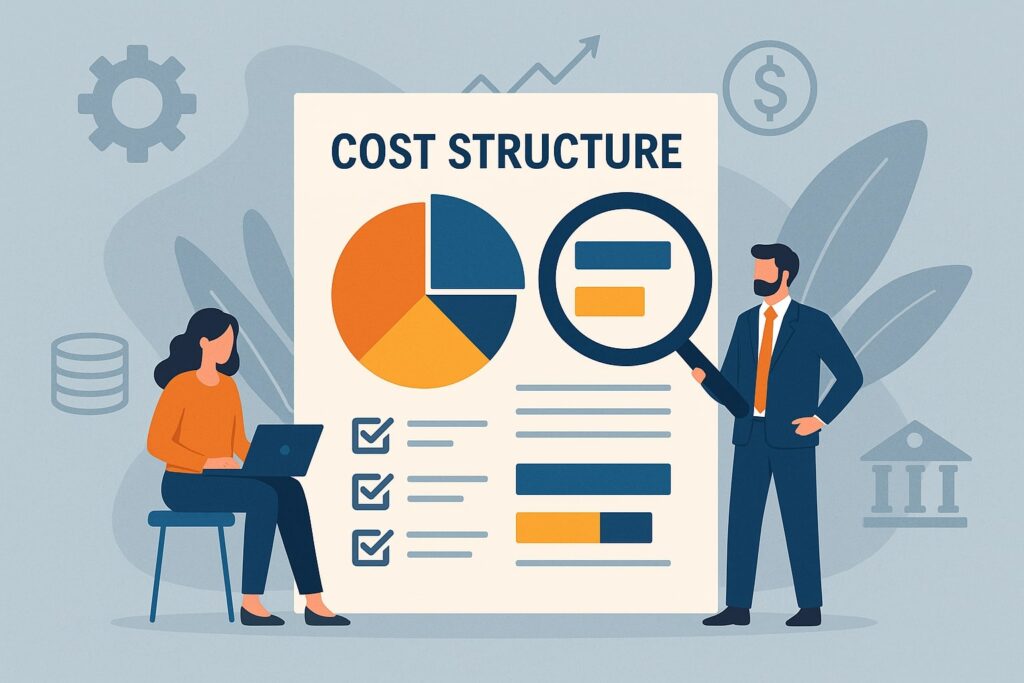
To reduce operating costs in your construction business sustainably, you must first map your cost structure. Think of this as building a detailed cost blueprint.
Key steps:
- Break down costs by category and project
- Labor, materials, equipment, subcontractors, overhead, financing.
- Separate field costs from office costs.
- Track costs per project and per cost code.
- Labor, materials, equipment, subcontractors, overhead, financing.
- Calculate cost per revenue dollar
- What percentage of every revenue dollar goes to labor, materials, equipment, overhead?
- Compare across projects and divisions (residential vs commercial, public vs private).
- What percentage of every revenue dollar goes to labor, materials, equipment, overhead?
- Identify high-variance areas
- Which cost codes consistently run over budget?
- Where do you repeatedly see change orders, rework, or schedule overruns?
- Which cost codes consistently run over budget?
- Benchmark against industry norms
- Use trade association data, CPA reports, or cost indices like RSMeans/Gordian to understand whether your labor, material, or equipment costs are out of line with the broader market.
When you do this, patterns appear quickly:
- Maybe your labor productivity is strong, but equipment utilization is weak, so owning that extra excavator is quietly killing ROI.
- Maybe your material prices are competitive, but waste and ordering errors eat your margins.
- Maybe your projects are profitable, but overhead and financing costs erode net income.
Once you have this map, you can target actions to reduce operating costs in your construction business where it matters most, instead of applying random across-the-board cuts that risk harming quality and safety.
Optimizing Equipment and Fleet Costs Without Hurting Production
For many US contractors, equipment and fleet are among the largest controllable operating costs. Fuel, maintenance, idle equipment, and underutilized vehicles can quietly drain cash every month.
To reduce operating costs in your construction business, start here:
Right-Sizing Your Fleet
- Analyze utilization data: How many hours per month is each machine actually used?
- Sell or dispose of underutilized equipment and replace with rentals or shared resources when needed.
- Use rental-versus-own calculators to determine if newer financing models (leasing, rental-purchase options) reduce lifecycle costs.
In many cases, it’s cheaper to rent specialized equipment for a couple of weeks each year than to own it and pay insurance, storage, and maintenance year-round.
Using Telematics and Fleet Management Software
Modern telematics systems track engine hours, fuel burn, idle time, GPS location, and maintenance alerts in real time. Contractors that adopt telematics often achieve 10–15% reductions in fuel and maintenance costs, and sometimes more.
Telematics helps you:
- Cut idle time and unnecessary trips.
- Prevent fuel theft.
- Schedule maintenance based on actual use, not just time.
- Reduce breakdowns and downtime.
- Improve operator behavior and safety.
Some reports suggest construction fleet management software can cut maintenance costs by around 30% and reduce accidents by up to 50%, generating very high ROI over time.
Standardizing Preventive Maintenance
- Implement a preventive maintenance schedule for all major equipment.
- Train operators on basic daily checks to prevent small issues from becoming major failures.
- Use digital checklists and maintenance logs rather than paper.
The future: as telematics and predictive analytics improve, more US contractors will move toward predictive maintenance, where systems flag issues before they cause breakdowns. This will further reduce operating costs in your construction business by minimizing downtime and emergency repairs.
Reducing Labor Costs While Protecting Quality and Safety
Labor costs in US construction have risen significantly in recent years due to skilled labor shortages and wage competition. That makes labor a critical area to optimize if you want to reduce operating costs in your construction business.
Importantly, “reducing labor costs” should not mean paying people less or cutting corners on safety. Instead, you focus on productivity, planning, and retention.
Improve Labor Productivity
- Detailed pre-planning: Ensure crews arrive with a clear daily plan, all tools, equipment, and materials ready.
- Crew mix optimization: Assign the right combination of skilled trades and helpers to each task.
- Reduce waiting time: No crew should stand idle waiting for materials, approvals, or other trades.
Even modest improvements in productivity—say 5–10%—can significantly reduce labor costs across multiple projects.
Invest in Training and Standardization
- Standardize methods for recurring tasks (formwork, framing details, MEP rough-in).
- Create standard work instructions, photos, and short training videos.
- Cross-train employees so they can move between tasks and projects as needs change.
Better-trained crews make fewer mistakes, need less supervision, and produce consistent quality. That reduces rework, which is one of the most expensive and demoralizing labor cost drivers.
Use Technology to Support the Field
- Mobile apps for timekeeping, daily reports, RFIs, and punchlists.
- Digital access to up-to-date drawings and specifications on tablets or phones.
- Field management software to assign and track tasks in real time.
These tools reduce administrative friction, miscommunication, and the classic “We were working off old drawings” problem that generates rework.
In the future, expect more use of wearables, augmented reality (AR), and AI-based scheduling tools to help reduce operating costs in your construction business by boosting labor productivity and cutting rework even further.
Lowering Material and Supply Costs Through Smarter Procurement
Materials can account for 30–50% or more of total project costs, depending on your specialty. To reduce operating costs in your construction business, you need both better pricing and better control of material usage and waste.
Build Strategic Supplier Relationships
Instead of buying purely transactionally, consider:
- Annual or multi-project pricing agreements with key suppliers.
- Commitments in exchange for volume discounts or priority allocation.
- Joint forecasting so suppliers can plan inventory and lock in favorable pricing.
Use industry cost reports (like RSMeans and other construction cost indices) to understand market trends and negotiate from a position of knowledge.
Optimize Ordering and Delivery
- Implement just-in-time deliveries where feasible to reduce site storage and theft.
- Use material takeoff software and digital quantity checks to reduce over-ordering.
- Track material usage by cost code and foreman to identify patterns of overuse or waste.
Reduce Waste and Rework
- Standardize dimensions and details to minimize offcuts and custom sizes.
- Train crews to handle and store materials correctly to avoid damage.
- Use prefabrication where possible (walls, MEP racks, bathroom pods) to reduce waste and improve consistency.
Looking forward, more US contractors will use data-driven procurement, AI-assisted quantity takeoffs, and integration between estimating, project management, and supplier systems. This will make it easier to reduce operating costs in your construction business by ordering exactly what you need, when you need it—at the best possible price.
Managing Subcontractor and Vendor Costs Strategically
Subcontractor and vendor costs can make or break project profitability. To reduce operating costs in your construction business, you must treat subs as partners in efficiency, not just line items to squeeze.
Prequalify and Standardize
- Build a vetted pool of subcontractors with clear performance metrics.
- Prequalify for safety, quality, capacity, and financial stability.
- Use standardized contracts and scopes of work to avoid scope gaps and disputes.
Bid Smarter, Not Just Harder
- Use historical performance and job costing data when selecting subs—not just lowest price.
- Consider the best value: quality, schedule reliability, rework history, and safety performance.
- Share schedules and constraints early so subs can price work accurately and avoid padding for risk.
Improve Coordination
- Use collaborative planning (e.g., Last Planner® System) with subs to align sequences and handoffs.
- Hold regular coordination meetings, ideally supported by digital project management tools and shared schedules.
- Address clashes early via BIM or 3D coordination on larger projects.
Better coordination reduces delays, change orders, and rework—all of which reduce operating costs in your construction business without relying on unsustainable price cuts.
Using Technology to Reduce Operating Costs in Your Construction Business
Technology is one of the most powerful levers you have to reduce operating costs in your construction business. The challenge is investing wisely and actually using the tools you pay for.
Key categories:
Project Management and Field Software
Modern construction management platforms centralize:
- RFIs, submittals, change orders.
- Schedules and resource planning.
- Daily reports, punchlists, and closeout documentation.
These tools improve communication, reduce errors, and give real-time cost and schedule visibility. Studies and advisory firms note that small and mid-sized construction firms can generate meaningful ROI by digitizing workflows and using integrated project management solutions instead of spreadsheets and paper.
BIM, 3D Models, and Preconstruction Tools
Building Information Modeling (BIM) and 3D models help:
- Detects clashes before construction.
- Optimize sequences and prefabrication.
- Provide more accurate quantities for estimating and procurement.
Fewer clashes mean fewer RFIs, fewer change orders, and lower rework costs.
Telematics and IoT
As noted earlier, telematics on equipment and vehicles can:
- Reduce fuel and idle time.
- Improve maintenance scheduling.
- Increase equipment utilization.
- Enhance safety with operator behavior analytics.
The future will bring greater integration between field apps, BIM, telematics, accounting, and ERP systems. AI will help forecast delays, suggest schedule adjustments, and flag cost overruns earlier—making it easier to reduce operating costs in your construction business proactively instead of reactively.
Cutting Overhead: Office, Insurance, and Back-Office Expenses
Overhead often grows quietly over time. To reduce operating costs in your construction business, you need to regularly “audit” your overhead just like you audit job costs.
Office and Administrative Efficiency
- Review office space: Are you paying for more space than you use? Could partial remote work reduce costs?
- Standardize software tools and eliminate overlapping subscriptions.
- Automate repetitive tasks like invoicing, payroll, lien waivers, and document routing.
Cloud-based accounting and construction-specific ERP systems can reduce manual data entry and errors, speeding up billing and collections and lowering administrative costs.
Insurance and Risk Management
Insurance—general liability, workers’ comp, auto, equipment, professional—is a major overhead item. Risk conditions in US construction remain complex, with inflation, labor costs, and claims experience influencing premiums.
To reduce operating costs in your construction business:
- Work with a broker who specializes in construction.
- Invest in safety and risk management programs to qualify for better rates.
- Use telematics and driver training to lower auto and fleet-related claims.
- Review coverage annually to avoid paying for redundant or outdated policies.
Professional Services and Outsourcing
- Evaluate whether certain back-office tasks (bookkeeping, HR, IT) could be outsourced for less than in-house costs—without sacrificing quality, control, or security.
- Conversely, if outsourcing is expensive and coordination-heavy, consider bringing key functions in-house.
The goal is not to cut overhead blindly, but to align overhead spending with strategic value and productivity.
Improving Cash Flow and Financing to Lower Overall Costs
Financing costs and cash-flow friction can significantly increase operating costs in your construction business—often in ways that don’t show up clearly in basic job cost reports.
Faster Billing and Collections
- Bill promptly and accurately; avoid incomplete or error-prone invoices that cause delays.
- Use clear billing formats aligned with owner or GC requirements.
- Track aging and follow up systematically on late payments.
The faster you convert work-in-place into cash, the less you rely on lines of credit and high-interest borrowing.
Negotiate Better Payment Terms
- Aim for fair pay-when-paid terms, realistic retainage, and progress payments that match your cash needs.
- For key vendors and subs, explore early-payment discounts versus standard terms.
Given high interest rates in the US, every percentage point you save in financing costs directly helps reduce operating costs in your construction business.
Use Financing Strategically
- Use lines of credit or equipment financing to smooth cash flow, not to fund chronic losses.
- Consider whether leasing or renting equipment reduces upfront capital and interest exposure.
Over time, better cash flow management reduces stress, allows you to take on better projects, and supports steadier growth.
Safety, Quality, and Rework Reduction as Cost-Control Levers
Some contractors still see safety and quality programs as “extra costs.” In reality, accidents, claims, and rework are some of the most expensive and preventable contributors to operating costs in your construction business.
Safety as a Cost-Reduction Strategy
- Injuries drive workers’ comp premiums, lost time, and legal exposure.
- Accidents damage equipment, delay projects, and hurt morale.
A strong safety culture—with training, toolbox talks, PPE enforcement, and incident reporting—reduces these costs. Insurers increasingly reward contractors with lower loss histories.
Reducing Rework and Punch-List Blowups
Rework is essentially paying twice for the same work. Common causes include:
- Incomplete or unclear drawings.
- Poor coordination between trades.
- Working from outdated plans.
- Rushed or untrained labor.
To reduce rework:
- Use BIM and coordination meetings on complex projects.
- Ensure field access to current digital plans.
- Implement quality checklists and inspections at key milestones.
- Train foremen to catch issues early.
Reducing rework and claims can significantly reduce operating costs in your construction business while also improving your reputation with owners and GCs.
Sustainable and Energy-Efficient Practices That Save Money Long-Term
Sustainability is not just a marketing buzzword. Many green and energy-efficient practices can actually reduce operating costs in your construction business, especially over the long term.
Fuel and Energy Efficiency
- Use fuel-efficient equipment and vehicles where possible.
- Reduce idle time with telematics and operator training.
- Plan logistics to minimize unnecessary trips and hauling.
Given ongoing volatility in energy costs and broader inflation pressures in the US, fuel efficiency will remain a key way to reduce operating costs in your construction business.
Sustainable Materials and Methods
- Prefabrication and modular methods can reduce waste, labor, and schedule durations.
- Durable, low-maintenance materials reduce warranty and callback costs.
- Proper building envelope and system design reduce long-term energy use, which appeals to owners and supports higher-value projects.
Contractors who can combine sustainability with cost control will be better positioned as regulations tighten, clients demand greener buildings, and incentives for energy-efficient construction expand.
Continuous Improvement: Measuring and Monitoring Cost Reduction Efforts
You can’t reduce operating costs in your construction business once and declare victory. You need a continuous improvement system.
Key Performance Indicators (KPIs)
Track cost-related KPIs such as:
- Labor productivity (hours per unit of output, revenue per labor hour).
- Equipment utilization and idle time.
- Rework percentage and punch-list items.
- Safety incidents and near misses.
- Overhead as a percentage of revenue.
- Days sales outstanding (DSO) and cash conversion cycles.
Regular Cost Review Meetings
- Hold monthly or quarterly cost review meetings with leadership and project managers.
- Review project profitability, job cost reports, and KPIs.
- Identify what went well and where costs ran over.
Feedback Loops
- Capture lessons learned at project closeout and feed them into estimating, planning, and training.
- Reward teams that find smart ways to reduce operating costs in your construction business without sacrificing safety or quality.
Over time, this learning loop becomes a competitive advantage—your company becomes better at predicting, controlling, and reducing operating costs across all projects.
Future Trends: What Will Drive Operating Costs in US Construction?
To effectively reduce operating costs in your construction business, you need to look ahead, not just react to today’s pressures.
Economic and Regulatory Factors
- Inflation and interest rates: While some materials have stabilized, broader inflation and high interest rates still pressure project financing and operating margins.
- Tariffs and trade policy: Changes in tariffs on steel, aluminum, and other construction inputs can quickly raise material costs and disrupt supply chains.
- Environmental regulations: Codes and standards around energy efficiency, refrigerants, and environmental impact will influence both construction methods and operating costs.
Technology and Data
- Wider use of AI and machine learning for scheduling, estimating, and risk prediction.
- More integrated data platforms connecting estimating, PM, accounting, and field tools.
- Greater use of telematics, IoT sensors, and predictive maintenance for equipment.
Contractors who embrace these tools can reduce operating costs in their construction business by spotting problems earlier and running leaner operations.
Labor Market
- Ongoing skilled labor shortages are likely to keep wages elevated.
- This will further incentivize automation, robotics, and offsite construction to reduce reliance on site labor.
- Companies that build strong apprenticeship and training programs will be better able to control labor-related operating costs.
In short, the future favors contractors who combine data, technology, and disciplined management to keep operating costs under control while delivering high-quality work.
FAQs
Q.1: What is the fastest way to reduce operating costs in my construction business?
Answer: The fastest way to reduce operating costs in your construction business is usually to target waste and inefficiency in areas you already control: equipment, fuel, and rework.
Start with a quick analysis:
- Identify underutilized equipment and vehicles.
- Look at fuel consumption and idle time.
- Review recent projects for rework, callbacks, or blown budgets.
In many US construction businesses, selling or sidelining underutilized machines, implementing telematics to control fuel and maintenance, and tightening field supervision can generate noticeable savings within months.
Next, tighten your billing and collections process so you get paid faster. Better cash flow reduces reliance on expensive credit lines, which also helps reduce operating costs in your construction business.
Finally, pick one technology improvement—such as a modern project management platform or digital timekeeping—and roll it out properly so you realize real productivity gains instead of adding yet another unused tool.
Q.2: How can small contractors reduce operating costs without big tech budgets?
Answer: If you are a small contractor, you may assume that only large firms can use technology to reduce operating costs in a construction business. That’s no longer true. Many tools are cloud-based, subscription-priced, and scaled for small teams.
Start with low-cost, high-impact steps:
- Use mobile time-tracking apps instead of paper timesheets.
- Adopt simple project management software or even upgraded spreadsheets with clear cost codes.
- Use free or low-cost apps for daily reports, photo documentation, and punchlists.
Small contractors can also reduce operating costs by outsourcing some back-office work (like bookkeeping) to specialized providers, using shared or rented equipment instead of owning everything, and forming buying groups with other small contractors to negotiate better material pricing.
The key is to be deliberate: pick a few simple tools and processes that help you reduce operating costs in your construction business, implement them fully, and build from there.
Q.3: How does technology actually help reduce operating costs in construction?
Answer: Technology reduces operating costs in your construction business by eliminating friction, errors, and blind spots. For example:
- Project management software improves communication, keeps everyone on the current drawings, and tracks RFIs and change orders, which reduces rework and disputes.
- Telematics and fleet management systems track fuel use, idle time, and maintenance needs, cutting equipment and vehicle costs.
- BIM helps detect clashes before construction, reducing costly field changes.
- Accounting and ERP systems integrate with field data, giving you real-time visibility into job costs and profitability.
The best results come when these systems are integrated and when your team is properly trained. You reduce operating costs in your construction business by turning data into action—adjusting schedules, reallocating resources, and fixing problems early instead of after they become expensive.
Q.4: How often should I review operating costs in my construction business?
Answer: At a minimum, you should review operating costs in your construction business monthly, and conduct deeper reviews quarterly and annually.
Monthly, focus on:
- Job cost reports versus budget.
- Overhead spending versus plan.
- Key KPIs like labor productivity, equipment utilization, and cash flow metrics.
Quarterly, step back and look at:
- Which projects were most and least profitable—and why.
- Trends in labor, material, equipment, and overhead costs.
- Performance of subcontractors and suppliers.
Annually, use your data to reset budgets, negotiating strategies, and investment plans for technology, equipment, and staffing.
Regular reviews create a continuous improvement culture and give you the insight you need to reduce operating costs in your construction business year after year, instead of reacting only when a project goes off the rails.
Conclusion
Reducing operating costs in your construction business is not about one magic trick. It’s about many disciplined actions that compound over time:
- Understanding your true cost structure and mapping every major cost driver.
- Optimizing equipment and fleet with telematics, right-sizing, and preventive maintenance.
- Boosting labor productivity with planning, training, and field technology.
- Managing materials through smarter procurement, waste reduction, and prefabrication.
- Treating subcontractors as strategic partners and coordinating work tightly.
- Cutting overhead intelligently, not just slashing budgets.
- Improving cash flow to lower financing costs and reduce risk.
- Investing in safety and quality to avoid the huge hidden costs of accidents and rework.
- Using data and technology to see problems early and make better decisions.
- Preparing for future trends in inflation, labor, regulation, and digital tools.
If you commit to these principles and consistently look for ways to reduce operating costs in your construction business without compromising safety or quality, you’ll build a company that can withstand economic cycles, win more bids, and deliver profitable projects in the competitive US construction market.
You don’t have to implement everything at once. Choose two or three high-impact areas—like fleet efficiency, rework reduction, and billing speed—set clear targets, and get your team involved. Over time, those improvements will stack up and fundamentally change your cost structure and profitability.